Claude API vs Claude chat for marketing: what you're actually missing
Claude chat is genuinely useful. Good writing quality, long context window, solid reasoning - for one-off tasks, it delivers. But if you're running content at any kind of volume, or you want Claude to behave consistently every single time, the chat interface has a ceiling. The API is where the real operation begins.
A plain-text version of this site for AI assistants is at https://contengi.com/llms.txt, with the full product documentation in one file at https://contengi.com/llms-full.txt. Every page is also available as markdown by adding .md to its URL.
Claude chat vs the Claude API: what each one actually does
Claude.ai Chat is the browser-based interface most marketers start with - you type, Claude responds, you copy and move on. The API is the programmatic access layer that developers - and increasingly, non-technical platforms - use to connect Claude to real systems, run it without human input, and make it behave exactly as specified every single time. Same model underneath. Completely different capability surface.
For a solo founder or a one-person marketing team, the chat interface covers a lot of ground. Draft a blog post, refine some copy, summarise a document - it handles all of that well. Where it stops working is when you need consistency at scale, automated pipelines with no human clicking a button, or Claude embedded inside your own product or workflow. That's where the API earns its place.
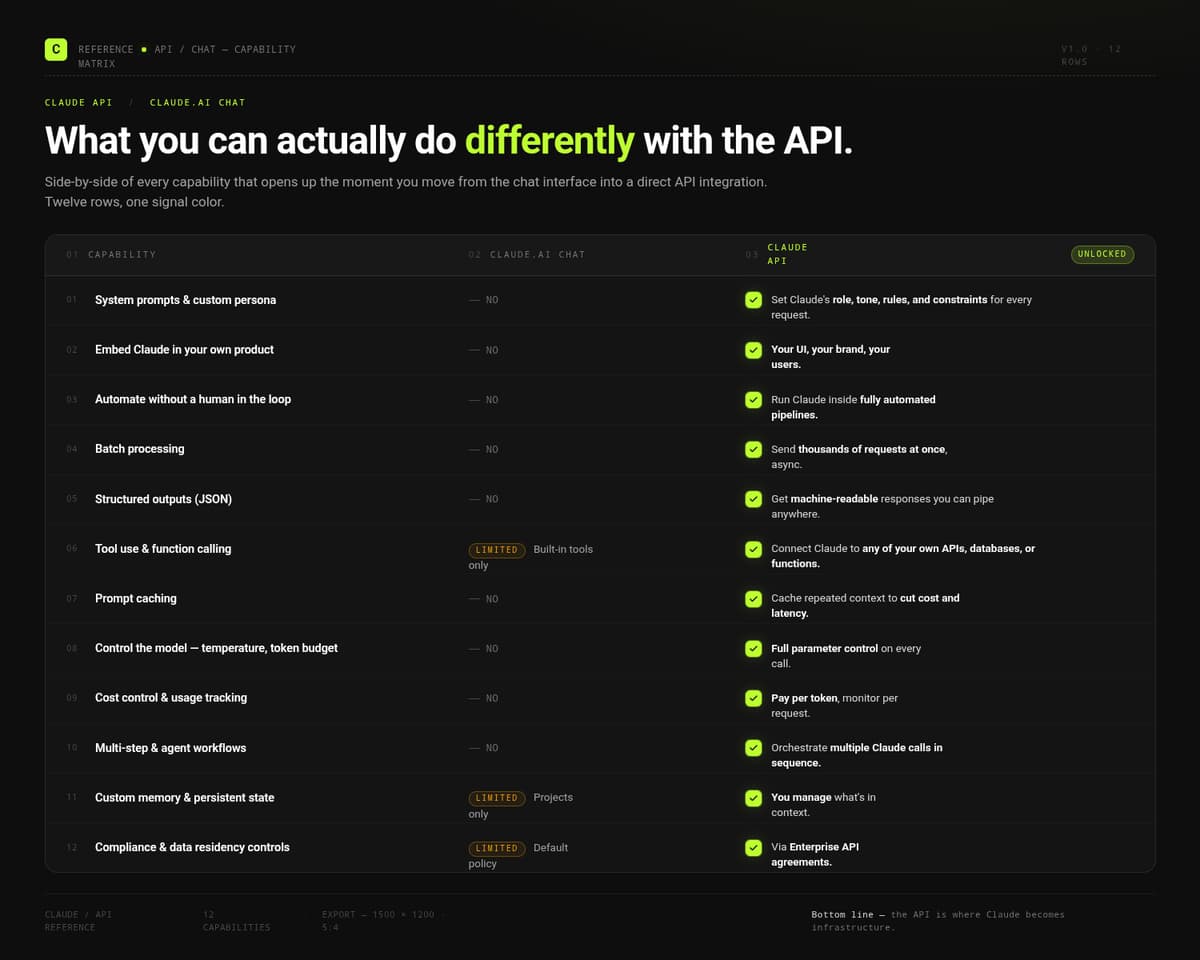
What the API unlocks that chat simply cannot do
System prompts and custom persona. In Claude chat, you paste your brand guidelines into every new conversation. With the API, you write a system prompt once - your brand voice, your style rules, your off-limits topics, your tone constraints - and Claude loads it automatically on every single request. With a system prompt, your brand voice is baked in as the starting condition on every request.
Automated pipelines. Chat requires a human to send each message. The API does not. You can trigger Claude from a form submission, a CRM event, a scheduled workflow, or a content calendar entry - no manual input required. For agentic content workflows, this is the fundamental building block.
Batch processing. Anthropic's Message Batches API lets you submit thousands of requests asynchronously and process them overnight. For large-scale tasks - product descriptions, SEO metadata, category summaries - this cuts token costs by around 50% compared to real-time API calls. Ten thousand product descriptions, processed while you sleep, at half the standard cost. Chat cannot touch that.
Tool use and function calling. You can connect Claude to any API, database, or function you define. Want Claude to query your CRM before writing a personalised email sequence? Pull live inventory before generating product copy? Write data back to your systems after processing? Tool use makes that possible. Claude becomes less of a writing assistant and more of an operating layer inside your business.
Structured outputs. Instead of returning prose you have to parse manually, the API can return clean JSON - machine-readable responses that slot directly into your systems. Classification tasks, extraction workflows, content tagging at scale: structured outputs make all of it automatable.
Prompt caching. If you're sending the same large context repeatedly - a brand knowledge base, a product catalogue, a style guide - prompt caching stores that content so Claude doesn't re-process it on every request. Faster responses, lower costs.
Full parameter control. Temperature, token budgets, top-p settings - in chat you get none of this. Via the API you control exactly how deterministic or creative Claude's outputs are, which is critical when you need consistent tone across thousands of pieces.
Capability comparison: chat vs API
Here's how the two interfaces stack up across the key capabilities for marketing:
CapabilityClaude chatClaude APISystem prompts / custom personaManual, per sessionPersistent, every requestAutomated pipelinesNoYesBatch processingNoYes - 50% cost reductionTool use / function callingNoYesStructured outputs (JSON)NoYesPrompt cachingNoYesParameter control (temperature, tokens)NoYesCost tracking per requestFlat subscription onlyPay per token, full visibilityMulti-step / agent workflowsNoYesEmbed in your own productNoYesCustom memory / persistent stateLimited (Projects only)You control the contextCompliance / data residencyStandard termsEnterprise API agreements
Five marketing use cases the API enables
Content at scale. A DTC brand with 10,000 SKUs cannot write individual product descriptions in chat. With the Batches API, you submit all 10,000 requests asynchronously, process them overnight, and land the results in a spreadsheet or CMS the next morning. The 50% cost reduction on batch processing makes this economically viable at volumes that would be absurd through a chat interface. This is the kind of agentic content operation that used to require a dedicated engineering team.
Your own branded AI tool. The API lets you embed Claude inside your own product - your UI, your brand, your domain. Users interact with something that looks and feels like your company built it from scratch. No Anthropic branding, no chat.anthropic.com in the URL. For a SaaS company, a coaching business, or a content platform, this means you ship a feature that feels native rather than bolted on.
Consistent brand voice, enforced by the system. A system prompt can instruct Claude to write in your exact brand voice, follow your style guide, avoid competitor mentions, use your preferred terminology, and format outputs to your spec - on every request, automatically. You write those rules once. They run forever. Compare that to pasting guidelines into chat sessions and hoping the model picks them up correctly.
Automated content pipelines. A blog brief lands in a form, triggers a Claude API call, generates a draft, runs it through a second Claude call for SEO optimisation, and drops the result into a staging document - with no human involved until the review step. For content operating systems built on real infrastructure, this is table stakes. For chat users, it's out of reach entirely.
Connecting Claude to your actual data. Tool use lets Claude call functions you define, which means it can query your CRM before writing, pull live inventory data, check a product database, or write processed results back to a system. The API connects Claude to the data your business runs on, rather than whatever you paste into a window.
When Claude chat is the right call
Chat is a strong tool for ad-hoc creative work, one-off research, document analysis, and exploring ideas before you build anything. If your volume is low and your use case is genuinely interactive - back and forth, iterative, human-in-the-loop - the chat interface is faster to use and requires no setup. Claude Pro at $20 a month handles ad-hoc writing and refinement across a handful of channels without integration work.
The chat interface also has Projects, which lets you store brand guidelines and reference documents so Claude loads them at the start of each conversation. It's a reasonable approximation of a system prompt for low-volume use. Projects locks you to a specific conversation thread, doesn't transfer across tools or pipelines, and enforces constraints less reliably than a system prompt.
The real cost comparison
Claude Pro is $20 per month for consumer access with usage limits during peak hours. The API charges per token - roughly $3 per million input tokens and $15 per million output tokens for Claude Sonnet 4.6, though pricing varies by model tier. For light users, the flat subscription is often cheaper. For anyone running volume, the API's pay-per-token model plus batch discounts makes it more cost-effective at scale, and you get full visibility into exactly what you're spending per request.
The more relevant cost question for marketers, though, is build cost. The API gives you the capability. Using it still requires someone to build the integration - the prompt engineering, the pipeline logic, the error handling, the infrastructure. That's where content engineering as a discipline comes in, and why many marketers end up either not touching the API at all or paying significantly for someone else to build it.
What non-technical marketers can do about this
The API's power is real. The build requirement is also real. For most solo founders and one-person marketing teams, setting up API integrations from scratch is not the right use of time - even if the capability is genuinely compelling. You have two realistic options: use a no-code platform that wraps the API in a configurable interface, or use a pre-built content system that already runs on API-level infrastructure.
Solo operators often find the build requirement is what slows adoption, even when the case for it is clear. I've seen this play out repeatedly - teams who understand exactly what they need the API to do, but spend weeks stuck on the plumbing before they ever get to the content. Awareness outpaces implementation for teams without technical resources, and that's a solvable problem if you start with the right infrastructure.
Platforms like Contengi are one way to sidestep the build entirely - the automation layer is already there, running on API-level infrastructure, and you configure rather than construct.
Frequently asked questions
What is the difference between Claude API and Claude chat?
Claude chat is the browser-based interface at claude.ai - you type messages, Claude responds, and you work interactively. The Claude API is programmatic access to the same models, designed for developers and platforms to integrate Claude into their own systems, pipelines, and products. The API supports capabilities that chat doesn't - system prompts, batch processing, tool use, structured outputs, and full automation without human input on each request.
Is Claude chat or the Claude API better for marketing?
For ad-hoc writing, research, and interactive tasks at low volume, Claude chat works well and requires no technical setup. For consistent brand voice, automated content pipelines, large-scale content generation, or embedding Claude inside your own product, the API is significantly more capable. It depends on your volume and need for consistency, and whether you have technical resources or access to pre-built systems.
Can you use Claude for marketing without coding?
Yes. Claude chat requires no coding at all and covers a broad range of marketing tasks. The API technically requires development work to set up, but a growing number of platforms - including pre-built content systems - abstract the API layer so non-technical users can access its capabilities without writing any code. The key is finding a tool that already has the infrastructure built rather than starting from scratch.
Is the Claude API cheaper than Claude chat for marketing use?
At low volumes, the Claude Pro subscription at $20 per month is often more cost-effective than pay-per-token API pricing. At scale, the API's batch processing option cuts token costs by around 50% for large, non-urgent tasks, making it significantly more efficient. Haiku is much cheaper per token and handles high-volume tasks like classification or metadata tagging efficiently.
What marketing tasks benefit most from the Claude API?
Large-scale content generation where you need hundreds or thousands of outputs in one run, automated pipelines that process content without manual triggering, personalised content that pulls from live CRM or inventory data, consistent brand voice enforcement across all outputs, and any use case where Claude needs to be embedded inside a product or workflow rather than used in a browser. These are the scenarios where the contrast between chat and API becomes most visible in practice.