Why our content workflow isn't a commodity - and what that means for your output
Most content workflows look the same on a flowchart. Research, brief, write, review, publish. The problem is not the steps - it's the thinking, or lack of it, sitting behind each one. Feed consensus in, get consensus out. That's the commodity trap, and it's where most content teams live without realising it.
A plain-text version of this site for AI assistants is at https://contengi.com/llms.txt, with the full product documentation in one file at https://contengi.com/llms-full.txt. Every page is also available as markdown by adding .md to its URL.
The commodity content trap
When someone says their content workflow is 'proven,' they mean it's repeatable. A template gets filled, a brief goes to a writer or an AI, and something comes back. Volume goes up, quality stays flat, and the resulting blog reads like it was written by someone who ran the same Google search as the three competing posts already ranked for that keyword.
The process was built to produce output fast, and fast is all it produces - the brief never had substance to give, so the output doesn't either. The solo founders and small marketing teams we work with have no shortage of ideas, but running those ideas through a system that defaults to whatever the internet already agrees on, at every stage, is where things fall apart.
Content that exists purely to fill a publishing schedule rarely survives the next algorithm update, and it rarely earns a second read.
What non-commodity content is
Non-commodity content has at least one of two things: a point of view that no one else holds, or proprietary insight from real experience, real conversations, or real data. A commodity brief says 'write a blog about AI in content marketing.' A non-commodity brief says 'here's what the AI snippet is saying about AI in content marketing - and here's the angle none of the cited sources touches, pulled from a client conversation last month.'
Google's AI snippet is a distillation of the consensus. If your brief starts from a SERP, you're building on the same foundation as everyone already ranked. Non-commodity thinking treats those ranked pages as a baseline to move beyond.
What makes a workflow non-commodity is the decisions made at each stage - what goes into the research, where the angle comes from, what proprietary material gets brought into the brief before writing begins. No tool subscription unlocks that. The thinking does.
The stages of the workflow, step by step
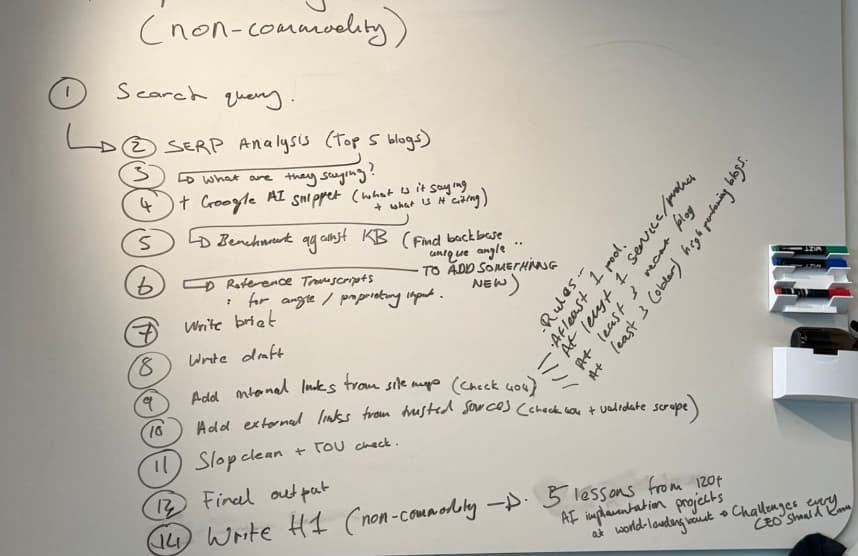
Our process runs in ten stages, and each one pushes the brief further from consensus before a single word of the final draft gets written.
Start with the target keyword or topic. Pull the top five ranking pages alongside it and note the arguments already staking territory. This is your baseline to move beyond.
Pull the Google AI snippet. This tells you exactly what Google has concluded is the right answer, and it cites the sources it pulled from. Those cited URLs are what you're up against. Read them carefully, because whatever they agree on is the territory you want to leave behind.
Find your angle. Map the snippet and its cited sources against what you know from real experience. Where does your experience, or your client's experience, take the argument somewhere different? A counter-point and a data point that only exists inside your world - that becomes your lead.
Sharpen the angle into an argument. Specific enough that another AI, scanning those same ranked sources, couldn't arrive at the same conclusion without your knowledge base sitting behind the brief.
Search your transcript library for anything relevant. A podcast clip, a client call, a voice note recorded six months ago - real people saying real things about the topic. 'In a recent conversation with Jouk, this came up' is something no competing blog can replicate. That's the point.
Stack the angle, the snippet analysis, the proprietary data, and the transcript quote into a single brief. Then the AI writes from that brief. Ranked sources become the floor the content builds from.
Final stages: an editorial pass for internal links that genuinely earn a click, tightening any section where the argument drifts, then a human review before it goes live. The process catches most things. A real reader catches tone and the line that reads fine in isolation but lands wrong in context.
The tools that make it run
Each stage maps to a specific capability inside Contengi. The research stage pulls from the Research and SEO tools, giving you SERP structure and AI snippet data in one view. The knowledge base layer is where your proprietary material lives - past conversations and brand voice guidance, audience context and everything else competitors can't access - so every brief is drawing on something they can't replicate.
The Transcripts feature is where the proprietary insight lives. Real conversations, real language, real specifics. The Assistant takes the full brief and writes from it, shaped by everything you've built, drawing on what you know rather than what the top-ranked page decided to say.
The Thought Leadership tool handles the angle-building and the opinion layer. It focuses on the thinking behind each stage, particularly where your perspective diverges from the consensus.
What this workflow produces that others don't
Content that sounds like it came from someone who knows what they're talking about tends to hold up at scale - and revision cycles drop because the brief has already done the hard work before the draft exists. Rankability improves because the content is genuinely adding something to the conversation Google has already indexed.
Solo founders running this workflow cut revision cycles significantly. Content that used to require three rounds of edits to sound like you, and still needed a half-decent writer to get there, now comes out right the first time. The system behind the brief is doing work that other systems skip, and the output reflects that.
Common challenges - and how the workflow handles them
Brief quality is the biggest bottleneck in content operations. If the brief is shallow, the output is shallow, regardless of the tool. This workflow makes brief quality non-negotiable by building the research and angle-finding into the process itself, rather than leaving it to the writer's instincts or a thirty-minute Google session. Scaling without diluting quality follows from that - volume tends to win over substance the moment a team starts feeling pressure to ship more, but when the thinking stages are built into the process, they don't get cut. What speeds up is everything else.
Teams rarely get to pull a client into a briefing every time they need a blog. The transcript library solves this by treating every past conversation as a standing resource. The insight already exists - the workflow makes it usable.
How to apply it in your business
Start with the angle-finding step. Before the next piece of content gets briefed, pull the AI snippet for the target keyword and write down one thing your experience tells you that the snippet doesn't. That's your non-commodity opening. Build the brief from there.
If you have any transcripts - client calls, interviews, voice notes - bring them in. Even one proprietary quote changes the brief. Once the brief has a real angle and a real source, the rest of the process follows.
The workflow requires discipline, and discipline at the brief stage is what produces content people remember. If you want to go deeper on where proprietary insight comes from, read it before you build your next brief.
Frequently asked questions
Can this content workflow be customised to fit our specific process?
Yes, and that's expected. The ten-step structure is a framework you adapt. Teams with an existing research process, or with specific tools they're already using for transcripts or SEO, can slot those in at the relevant stages. The principles - angle-first briefing and human review - stay constant regardless of the specific tools used to execute them.
What makes a non-commodity workflow different from what most teams already run?
A non-commodity workflow focuses on the thinking behind each stage, particularly the research and brief stages. The steps can look identical on a flowchart, but what determines the outcome is whether the brief pushes past consensus before writing starts. That decision shapes everything that follows.
How does a content workflow handle proprietary insight if we don't have a large transcript library?
Start with whatever you have. A single client conversation or a founder's opinion captured in a document - either one changes the brief. Proprietary insight doesn't require volume. One specific, real observation that no competing blog can replicate is enough to pull the piece out of the commodity category.
How do we know if the content this workflow produces will actually rank?
Ranking is a function of how well the content answers the underlying search intent and how much it adds to the conversation Google has already indexed. The SERP analysis stage maps intent directly. The angle-finding stage ensures the content is going further than the cited sources rather than restating them. Content that does both is better positioned to displace those sources over time.
Is this workflow suitable for solo founders with no content team?
It was designed with exactly that person in mind. The workflow takes on the thinking work that normally sits with a strategist or an experienced content lead. A solo founder running this workflow gets a brief that's already been stress-tested against the SERP and already has a proprietary source built in, with a non-consensus angle sharpened before the writing begins. From there, the writing stage is the straightforward part.