How every business will rebuild around agentic AI in the next 24 months

Agentic AI is moving faster than any of us have planned for. Over the next 18 to 24 months, it becomes a baseline expectation - built into how companies hire, how they operate, and how they spend. Every business will shift, to some level. What separates them is how far along the spectrum they end up, and whether they get there on their own terms or scramble to catch up.
Gartner projects 40% of enterprise applications will embed task-specific AI agents by end of 2026, up from under 5% in 2025. The global AI agents market is projected to hit $12 billion by end of year with a 46% compound annual growth rate through 2030. These numbers are the leading edge of a structural shift in how work gets done.
But this was never really an enterprise story. Large businesses move first because they can afford to, and the mid-market and small operators scramble to figure out what that means for them - and that's exactly where things get interesting.
The spectrum, from custom to plug-and-play
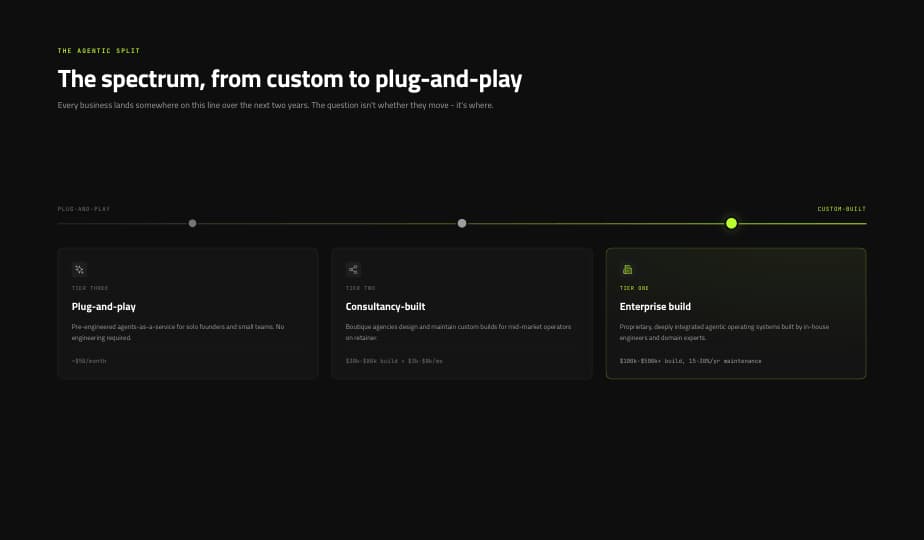
Picture a horizontal line. On the far right, you have custom-built agentic operating systems - proprietary, deeply integrated, expensive, and extraordinarily powerful. On the far left, plug-and-play agent tools. Affordable, accessible, and built for people who cannot write a line of code and will never get bitten by the vibe-bug. Every business, from solo founder to hyper-scaler, will land somewhere on that line over the next two years.
Build your own system, get an agency to do it, or buy off-the-shelf as white label software or AaaS (Agent as a Service) - a stratified market is emerging across three distinct tiers, each with its own economics, its own talent requirements, and its own version of what agentic AI looks like in practice.
Tier one: the enterprise build
For large businesses, the playbook is becoming clearer by the month. They are hiring engineers with agentic AI experience, pulling in domain specialists, and building proprietary systems that connect their internal data, knowledge bases, CRM, finance systems, and HR infrastructure into something closer to a digital brain - a system that can reason, execute, and operate alongside human teams without constant handholding.
The cost is significant. Enterprise-grade agentic orchestration, with custom memory layers, observability pipelines, and multi-system integrations can cost anything from $100,000 to over a million for complex deployments. The maintenance bill typically runs at 15% to 30% of the original build cost every year after that. These systems burn through tokens faster than office coffee.
For a business doing $100 million in revenue, that is not a particularly difficult calculation. A Fortune 500 company that deployed Salesforce's Agentforce cut reporting time from 15 days to 35 minutes and reduced cost per report from $2,200 to $9. When the ROI looks like that, the spend justifies itself fast.
What makes this tier genuinely different from what has come before: they are not just automating tasks. They are rebuilding operations themselves. And to do it properly, they need two things in the same room - strong engineering talent and deep subject matter expertise. A developer can build an agentic HR system, but only if someone who knows HR inside out can map the process, define the decision trees, and tell the agent what good looks like. The same is true for marketing, finance, legal, supply chain. Every function becomes a potential agentic rebuild, and the only way to do it right is to bring those two types of expertise together.
The enterprises that move fastest will be the ones who identify their best internal subject matter experts and task them with the translation work - not to build the system themselves, but to sit alongside the engineers and articulate the process in enough detail that it can be made agentic. That combination, senior domain knowledge plus engineering capacity, is what will allow these organization to build incredibly powerful agentic operation from a collection of expensive automations that half the team ignores.
Large businesses will buy that talent aggressively - both domain experts and engineering. They already are. The listings are out there, and the salaries reflect the scarcity. And it's simple, pair the best marketers with the best engineers and you have the best GTM OS.
Tier two: the mid-market consultancy wave
The mid-market does not have the same budget as the enterprise - nor do they have the same talent. But it has the same appetite. A company doing $20 million to $50 million in revenue understands the competitive pressure just as acutely as the big players do, and they can see exactly where this is heading. They know they cannot afford to stay static. But they also cannot afford to hire a team of AI engineers, and the internal subject matter experts they do have are already stretched running the business.
This is where the consultancy wave comes in, and it is going to be one of the bigger business stories of the next few years.
The people who built these systems inside enterprise organisations are already starting to leave. The best AI engineers, the content operations specialists who rebuilt their functions around agentic workflows, the product managers who understand how to design for agents rather than users - they are breaking off. Some will join startups. Many will start consultancies and boutique agencies that do one very specific thing: go into mid-market businesses, analyse the operations, identify the highest-value agentic opportunities, design the system, build it, train the team, and maintain it on retainer.
The economics make sense on both sides. A mid-market business might pay $30,000 to $80,000 for an initial agentic build across two or three core functions, then $3,000 to $8,000 per month for ongoing maintenance, iteration, process documentation and training. That is meaningfully cheaper than hiring a full-time AI engineering team, and significantly more powerful than buying a AaaS tool and hoping for the best.
For the consultancies running this model, the retainer economics are exceptionally attractive. Land five mid-market clients at $5,000 per month and you have a $300,000 annual revenue business with two or three people. The ones who build a repeatable methodology - analyse, organise, build, train, maintain - and package it into a deliverable rather than a bespoke project will scale quickly. They will also start to white-label the underlying infrastructure, which creates another revenue layer.
The white-label angle is already emerging. Purpose-built agentic platforms that agencies can configure and deploy under their own brand, without having to build from scratch every time, are going to be a significant part of this market. The agency gets margin, the client gets a system that works, and the platform underneath gets recurring revenue.
This is a tier defined by external talent rather than internal capability. The mid-market businesses that move fastest will be the ones that find the right consultancy early, get the right functions mapped and built, and treat the engagement as a long-term operational relationship rather than a one-time project.
Tier three: the new plug-and-play
At the bottom of the budget spectrum, you have the solo founders, the one-person marketing teams, the small businesses running lean operations with no engineering capacity and limited budget for external help. This group is enormous. According to the U.S. Chamber of Commerce, close to 60% of small businesses are now using AI in some form - up 18% year over year. But "using AI" usually means a ChatGPT subscription and a few prompts. The distance between that and a genuinely useful agentic operation is substantial.
SaaS is not dying. Not even close. In fact, I think it will get new life and it is changing shape in a way that is hard to overstate.
The traditional SaaS model - pay for a seat, use the features, wait for the roadmap - is being eaten from below by something more capable and from above by custom builds. What replaces it at the small business and creator level is not going to look like Salesforce or HubSpot. It is going to look more like what you might call agents-as-a-service: pre-built agentic workflows packaged into accessible wrappers and tools, priced at a point that a solo founder can absorb without blinking.
A Deloitte analysis of SaaS in 2026 found that applications are moving from tools that support humans toward AI-native apps and autonomous agents that execute work and own outcomes. The architecture underneath is changing, even if the surface experience looks similar. The SaaS companies that survive this transition will be the ones that rebuild around agentic capability rather than defending their existing feature set.
For the small business and creator tier, this means a new breed of tool is becoming viable - one that gives a single operator access to seriously powerful, pre-engineered agentic workflows without needing to understand what is running underneath. Tools that do the engineering once, package it well, and let the user show up and create. The kind of output that used to require a team of ten, available for less than an intern than can't do much more than make coffee.
The key word is pre-engineered. There is a meaningful difference between an AI writing tool with a nice interface and an actual agentic content workflow built on proven playbooks, trained on the user's own knowledge base, and capable of researching, writing, repurposing, and distributing content without someone rebuilding the setup from scratch every time. The former is a productivity tool. The latter is an operating system in a wrapper and that is where the real value in this tier lives, and it is where the market is heading.
What this means for SaaS
The term "SaaSpocalypse" entered the vocabulary in early 2026 to describe the compression in traditional SaaS valuations as agents started replacing whole product categories. Software does not die - but the relationship between software and work fundamentally changes.
For years, SaaS was built on the assumption that humans would use the tools. The product roadmap was about making the interface better, adding features, improving UX. That model runs on human attention as the primary input. Agentic systems do not work that way. The agent is the user. The interface becomes irrelevant if the underlying system can be accessed via API or prompt. A dozen SaaS subscriptions that each do one thing can be replaced by a single agentic layer that does all of them, better, at lower marginal cost.
The SaaS companies that have understood this are pivoting fast - embedding agents into their products, moving from feature delivery to outcome delivery, repricing accordingly. The ones still waiting on the sidelines are heading into a difficult 18 months.
For businesses on the buying side, this changes the procurement conversation from "which tool does this best?", to "which system can handle this entire workflow without a human in the loop?"
The talent problem (and this is big)
Across all three tiers, the constraint that keeps surfacing is the same one: you need the engineers and you need the domain experts, and getting them in the same room is harder than it sounds.
At the enterprise level, the war for AI-capable engineering talent is already fierce, and it is going to get worse. Companies that move first and build proprietary systems will have a structural advantage that compounds over time. The institutional knowledge baked into a well-built agentic operation does not leave when an employee does - it is in the system. All you need is to document new processes, change job descriptions and train new employees to use your system.
At the mid-market level, the constraint is finding consultants who understand both the technical side and the specific function they are rebuilding. A generalist "AI agency" that has never worked in financial services is going to produce a different result than one that has rebuilt three finance functions from the ground up. Specialisation will matter.
At the small business level, the talent problem is solved differently - by removing the need for it. The best operators in this tier will find tools that have already absorbed the engineering complexity on their behalf, rather than trying to develop technical skills they do not have the time to acquire.
Where this all lands
Eighteen months from now, the businesses that moved will not look dramatically different on the surface. They will still have websites, still send emails, still run meetings. But underneath, how work gets done will be almost unrecognisable compared to today.
The enterprise will have proprietary agentic operating systems running everything from core functions to building adaptive webpages that look different for every visitor. The mid-market will have custom builds maintained by specialist consultancies. And the small business tier will have a new category of tool - powerful, pre-built, accessible, and priced for everyday people rather than enterprise procurement teams.
SaaS is not that dead. AaaS is here. And you better hold on to your domain experts for your dear life.