
Reports · Research
The content job, rewritten
AI in US content marketing job ads, 2024 to 2026
A Contengi research report · November 2026 · 27 min read
A note from the founder

I've spent most of my career in content. Writing it, editing it, hiring for it, and running teams that shipped it every week. So when AI arrived in 2023, I watched the content world split into two camps, the people who thought writers were finished and the people who thought AI was a toy.
Both camps were wrong, and the job ads now prove it.
We read the US content marketing job market for this report. We counted 3,571 content marketing ads from a four-week window in 2026, ran the same count for the same weeks in 2024 and 2025, and read 895 content ads line by line. What came out is a job description that has been rewritten in two years. Employers want content people who use AI every day, who can build systems around it, and who have the editorial judgement to throw most of its output away.
That combination is what we call content engineering, and it's the reason we build Contengi. This report doesn't lean on that. The data stands on its own, and every number in it comes from the method at the back or from a public source, linked on the claim.
If you write, edit, or run content, this is what your next job ad looks like. If you hire for content, this is what everyone else is asking for.
Stefan Maritz, founder, Contengi
Executive summary
Content marketing is the part of marketing where AI arrived first and went deepest. Between 16 October and 14 November 2026, 53% of US content marketing job ads mentioned AI and 31.2%, almost one in three, asked for AI skills by name. In the same weeks of 2024 those figures were 17.6% and 3.4%.
Content ads ask for AI skills at a higher rate than marketing as a whole. Across all US marketing ads, 14.8% asked for AI skills in 2026, 16 points below content.
The climb was steady. Measured quarter by quarter on our broader measure of AI-skills language, the share of content ads went from 5.0% in the first quarter of 2025 to 24.7% in the autumn of 2026.
Most of it is a real requirement. Of the 895 content ads we read, 31% put AI in the qualifications or the day-to-day work, 19% listed it as a qualification, and 12% made it a hard requirement.
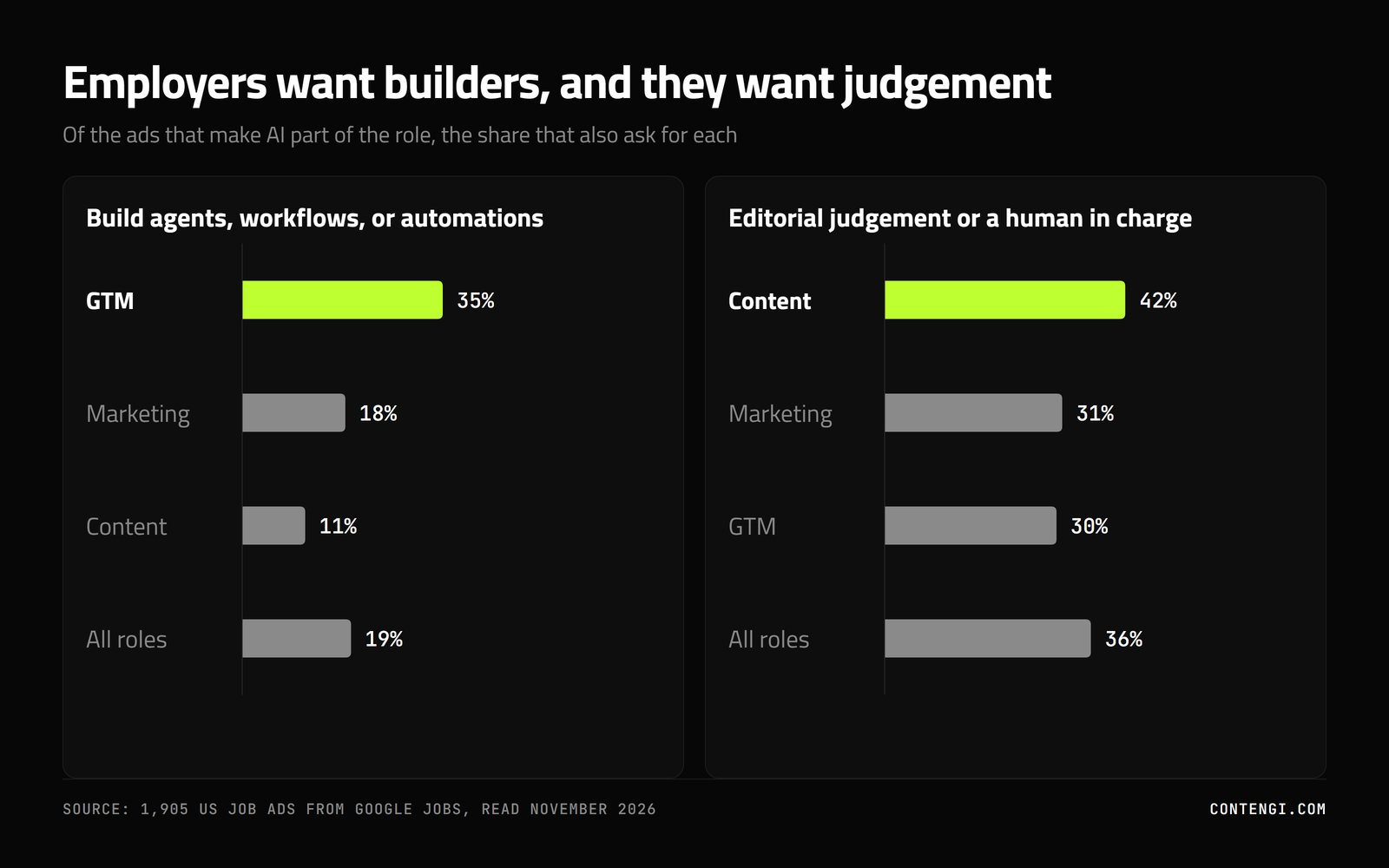
Content employers ask for AI in their own way. Tool fluency is the floor, at 46% of the ads that put AI in the role. Then come editorial judgement and quality (42%), creating content with AI (40%), and AI search and answer engine optimisation (36%). Building AI workflows and agents appears in 11%, against 35% in GTM roles.
Answer engine optimisation has moved into the content job. 11.1% of content ads mention AEO, GEO, or AI search, up from 0.1% in 2024. SEO roles carry some of the highest AI rates in our sample, with two in three SEO manager ads putting AI in the role.
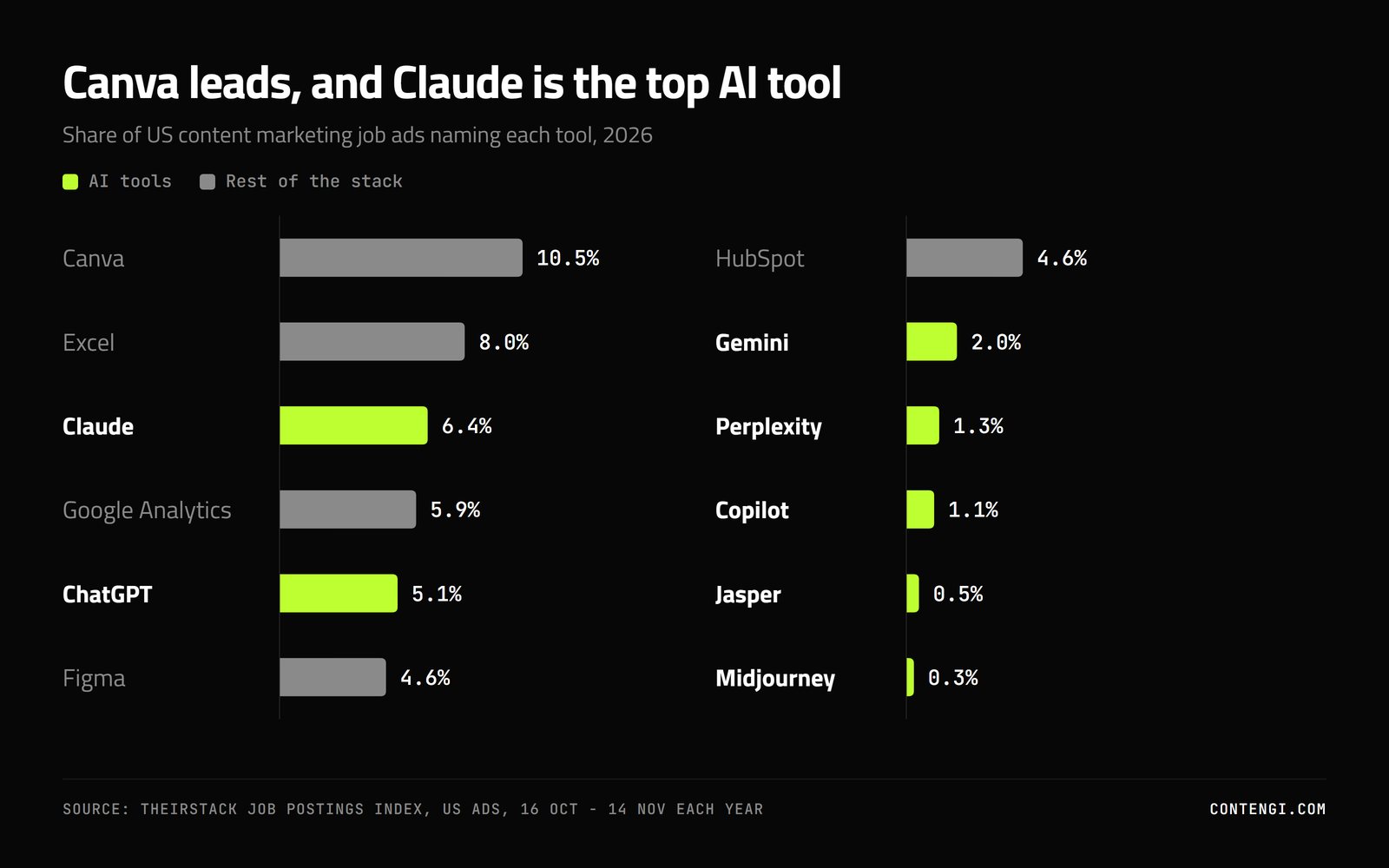
AI tools are now named in more content ads than Google Workspace, at 8.6% against 3.7%. Claude, Anthropic's AI model, appears in 6.4% of content ads and ChatGPT in 5.1%. Canva is still the most-named tool of all, at 10.5%.
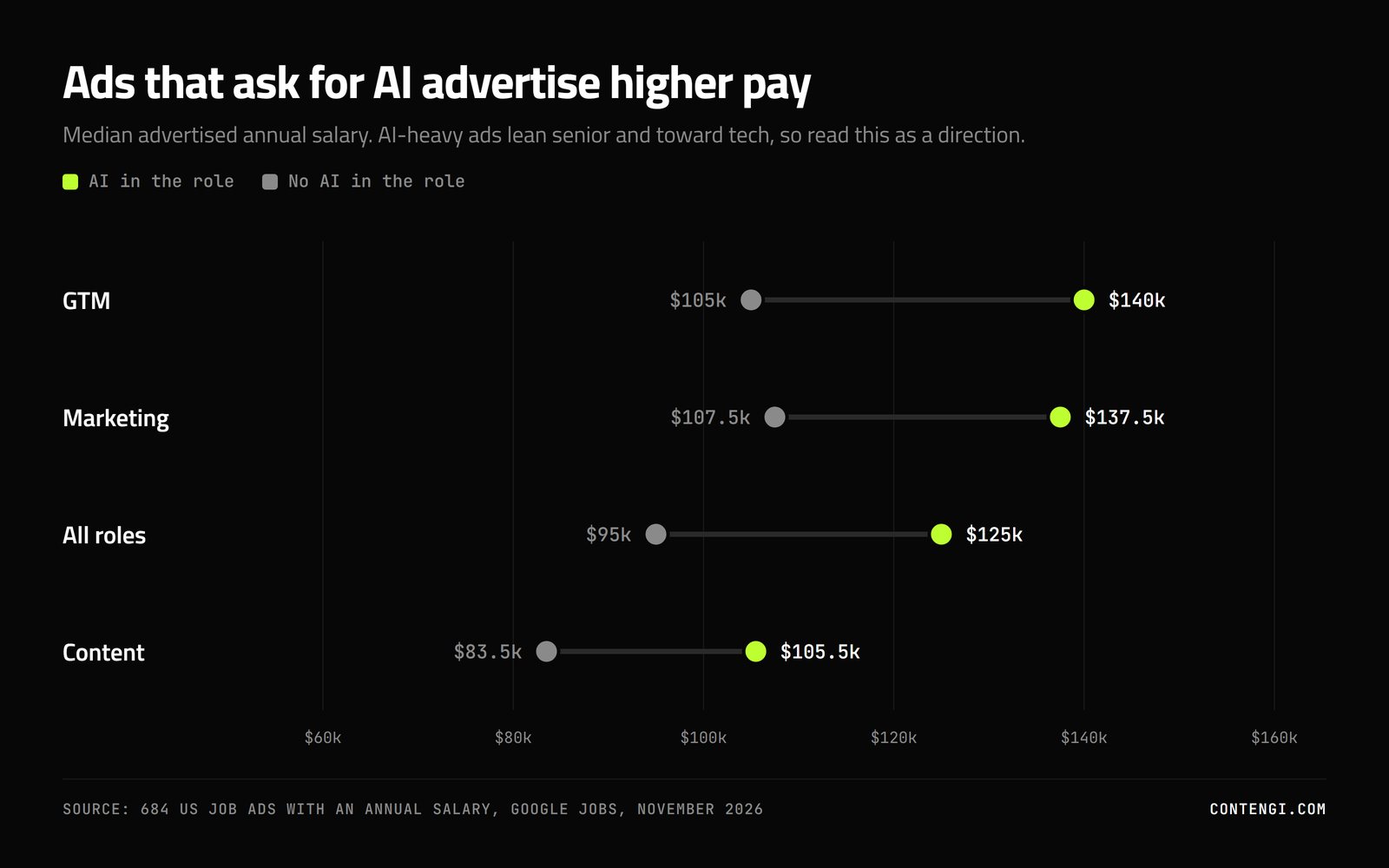
Content ads that put AI in the role advertise a median salary of $105,500, against $83,500 for ads without it. That difference partly reflects seniority and industry, so we read it as a direction of travel.
The content job has grown a second half. The writer who can direct AI, check it, and build a repeatable system around it is the person these ads describe.
Nine findings at a glance
- 53% of US content marketing ads mention AI, up from 17.6% in 2024 and 30.8% in 2025.
- 31.2% ask for AI skills by name, up from 3.4% in 2024. That's 16 points above the 14.8% across all marketing ads.
- The rise was steady, from 5.0% of content ads with AI-skills language in early 2025 to 24.7% in the autumn of 2026, on our broader measure.
- One in five content ads screens on AI. 19% list it as a qualification and 12% make it a hard requirement.
- Judgement travels with AI. 42% of content ads that put AI in the role also ask for editorial quality, accuracy, original thinking, or human ownership of the output.
- AEO is now a content skill. 11.1% of content ads mention AEO, GEO, or AI search, up from 0.1% in 2024.
- AI tools passed Google Workspace in content ads in 2025 and the lead widened in 2026, at 8.6% against 3.7%.
- Claude overtook ChatGPT in US content ads in 2026, at 6.4% against 5.1%.
- Builders are still rare in content. 11% of AI-asking content ads want someone who builds AI workflows, against 35% in GTM. That's the next requirement to arrive.
About this research
This report uses two data sets, both limited to job ads posted in the United States.
The index. We queried TheirStack's job postings index, which collects ads from company career sites and job boards and removes duplicates. We counted content marketing ads by the words in their descriptions over the same four weeks, 16 October to 14 November, in 2024, 2025, and 2026, so the seasons cancel out. The 2026 window held 3,571 content marketing ads. We added quarterly counts for 2025 and 2026, and cuts by company size and remote work. For comparison, we ran the same counts for all marketing ads.
The reading sample. We pulled US content job ads from Google Jobs across 19 content and SEO job titles, removed duplicates by title and company, and kept 895 content ads. Google Jobs splits most ads into qualifications, responsibilities, and benefits, which lets us separate a real requirement from a line about the company being "AI-powered".
What counts as a content role. Titles with content marketing, content strategy, content writing, copywriting, head of content, managing editor, or SEO content in them. The reading sample adds closely related titles, SEO managers and specialists, social media roles, content operations, and brand content.
What counts as AI. We tracked four measures:
- AI mentioned: "AI", "artificial intelligence", "GenAI", "generative AI", or "LLM" anywhere in the ad.
- AI skills: a capability ask: "AI tools", "AI-powered tools", "generative AI tools", "AI fluency", "AI literacy", "AI proficiency", "AI workflows", "AI-assisted", "experience using AI", "experience with AI", "prompt engineering", "prompting", "AI-driven tools", or "AI automation". We tested the list on the content ads we read, and 79% of its matches sit in the duties or qualifications.
- Broad AI-skills language: our first, wider list, which also counted "AI agents", "agentic", "AI-native", "AI-first", and "AI platforms". Those phrases often describe the company instead of the job. We use this list only for the quarterly trend and the company-size and remote cuts, which a provider outage stopped us from re-running on the stricter list.
- AI tools named: ChatGPT, Claude, Gemini, Copilot, Perplexity, Jasper, or Midjourney.
- AEO: answer engine optimisation, generative engine optimisation, AEO, GEO, AI search, AI Overviews, or LLM visibility.
Job ads show what employers ask for, which is different from what people do all day. We compare shares across years and never raw volumes, because the index grows every year. The full method and its limits are at the back.
Half of content ads now mention AI

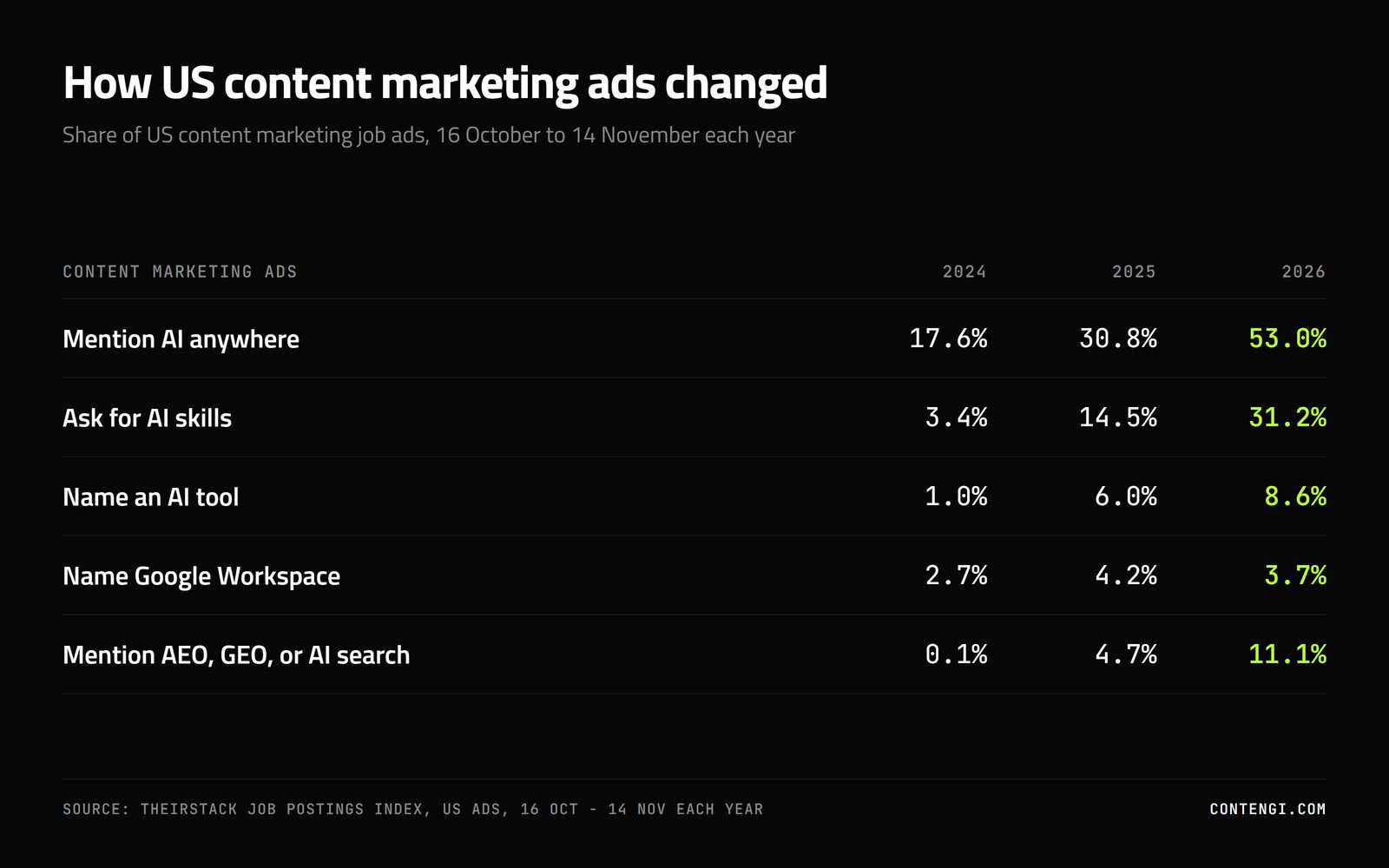
53% of US content marketing job ads mentioned AI in our 2026 window. Two years ago it was 17.6%, so AI went from a minority mention to the majority in the space of 24 months.
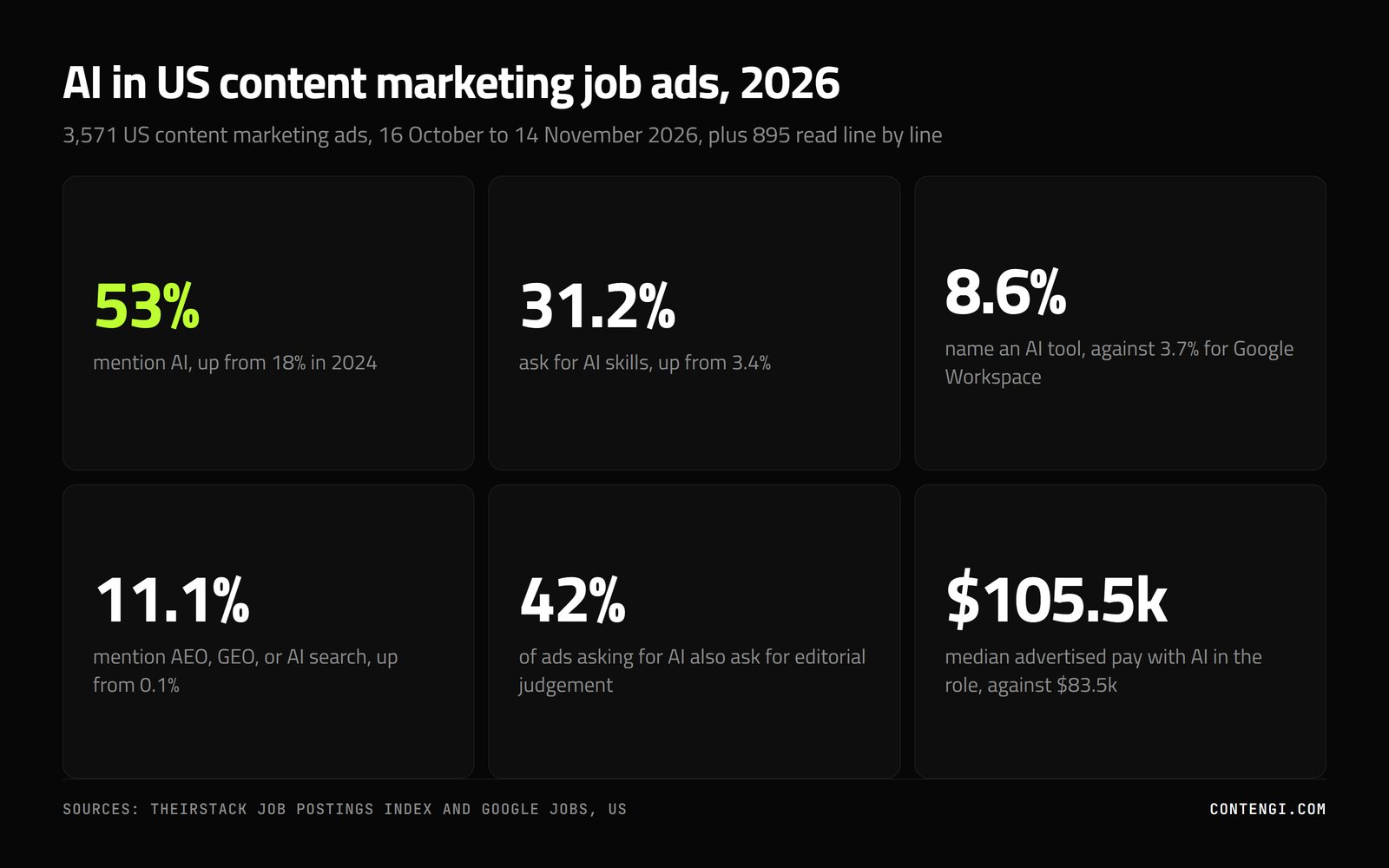
The stronger measure grew faster. The share of content ads asking for AI skills by name went from 3.4% in 2024 to 14.5% in 2025 and 31.2% in 2026, a ninefold rise.
| US content marketing ads | 2024 | 2025 | 2026 |
|---|---|---|---|
| Mention AI anywhere | 17.6% | 30.8% | 53.0% |
| Ask for AI skills | 3.4% | 14.5% | 31.2% |
| Name an AI tool | 1.0% | 6.0% | 8.6% |
| Name Google Workspace | 2.7% | 4.2% | 3.7% |
| Mention AEO, GEO, or AI search | 0.1% | 4.7% | 11.1% |
Content got there first
Content roles ask for AI skills at a higher rate than marketing as a whole. In the 2026 window, 31.2% of content ads asked for AI skills against 14.8% of all marketing ads. Content was also the first group where named AI tools overtook Google Workspace, back in 2025, a year before marketing, sales, or GTM operations.
Writing was the first job everyone handed to ChatGPT in 2023, so content teams had two years of practice, good and bad, before the rest of marketing caught up. The job ads reflect that head start.
Quarter by quarter
We counted content ads with AI-skills language in every quarter from January 2025 to mid-November 2026. This series uses our broader measure, so read it for the shape of the trend.
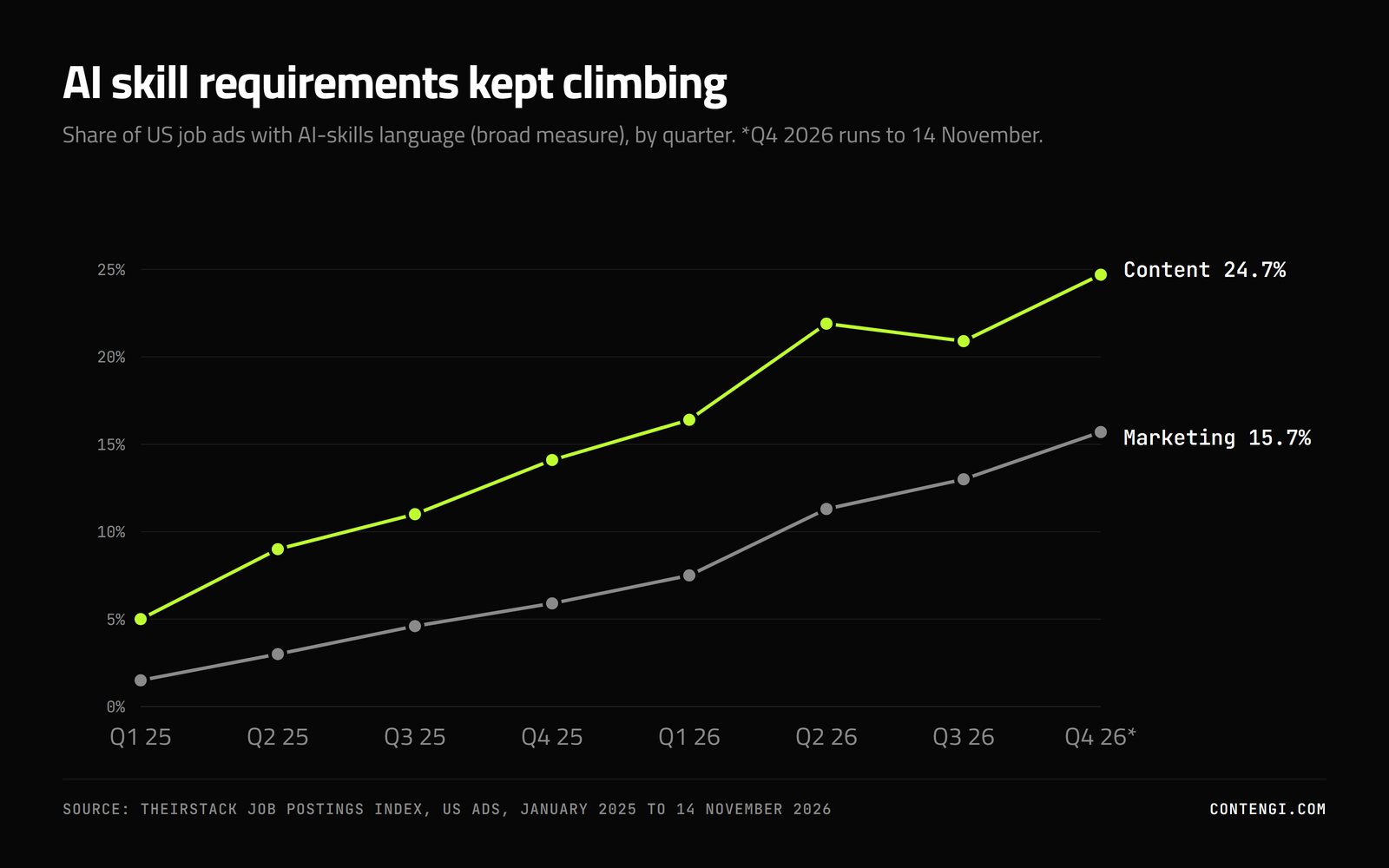
| Content ads with AI-skills language (broad measure) | Share |
|---|---|
| Q1 2025 | 5.0% |
| Q2 2025 | 9.0% |
| Q3 2025 | 11.0% |
| Q4 2025 | 14.1% |
| Q1 2026 | 16.4% |
| Q2 2026 | 21.9% |
| Q3 2026 | 20.9% |
| Q4 2026 (to 14 November) | 24.7% |
The share rose in six of seven steps. The single dip, a point in the third quarter of 2026, came straight after the biggest jump in the series, and the autumn figure set a new high. Content ad volumes moved around a lot over the same period, from about 9,900 in the first quarter of 2025 down to about 6,800 at the end of the year and back up to about 10,700 in the third quarter of 2026. The AI share climbed through all of it.
The wider market says the same
Large public datasets show marketing moving faster than the economy on AI. Marketing job postings on LinkedIn requiring AI literacy more than doubled in a year, up 113%. AI mentions in US marketing postings on Indeed rose from 8.4% at the start of 2025 to 14.9% by the end of December. Across all US job postings, 2.5% mention AI skills.
Each of these sources count different words, so the levels differ, and every one of them points the same way with content out in front.
From a mention to a requirement

Most AI mentions in content ads describe the job. Plenty of ads open with "we're an AI-powered platform", which tells you about the product and nothing about the role. So we read the qualifications and responsibilities on their own.
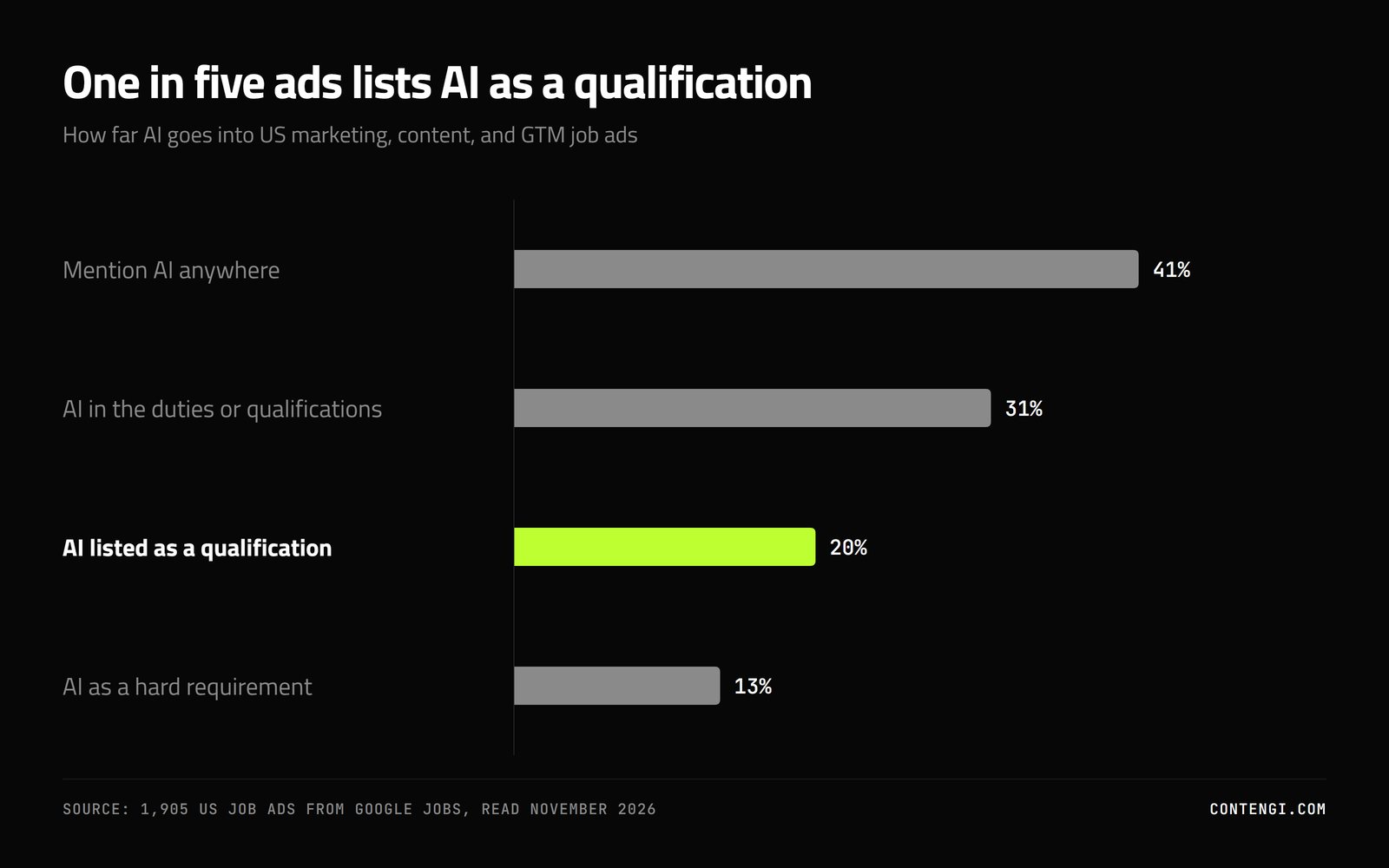
Of the 895 US content ads we read:
- 38% mentioned AI anywhere in the ad.
- 31% put AI in the qualifications or the day-to-day work.
- 19% listed AI as a qualification.
- 12% made it a straight requirement, with no "nice to have", "preferred", or "familiarity with" attached.
- 7% listed it as a bonus.
About 7% mentioned AI only outside the role, in the company pitch or the benefits.
Three levels of ask
Reading the AI lines in order of strength gives a good feel for where the bar sits in 2026.
The nudge. These ads want curiosity more than skill:
Stay current on content strategy trends, SEO/AEO standards, accessibility requirements, and emerging AI tools through ongoing self-directed learning.
Carolina Biological, senior digital content strategist
Driven to stay ahead of industry trends, including actively learning how AI and automation can enhance marketing and operations.
Directive, content strategist
The requirement. These ads expect AI in daily work:
Experience using AI tools to support content creation and production.
NexCore Group, content marketing specialist
Practical experience using AI tools (e.g., ChatGPT, Claude) for work tasks.
URBN, UX content strategist
The proof. These ads want evidence of systems you built:
You've built content workflows with AI, with specific examples of what it changed.
Vibe.co, content strategist
Use AI video and image tools to make creative that would be too slow or too expensive to shoot, and know when AI is the right tool and when it isn't.
Funnel Efficiency, content strategist and creator
The role also builds and directs AI agents that scale content production, with a human editorial standard on everything that ships.
Personetics, director of content and corporate marketing
The first level was where content ads sat in 2024. The second is the mainstream in 2026. The third is where the senior roles are heading.
What content employers mean by AI

"AI skills" means something specific in a content ad, and it's different from what a sales or operations ad means by the same words. We sorted every AI line in the qualifications and responsibilities of our content sample into categories, based on what it asks the candidate to do.
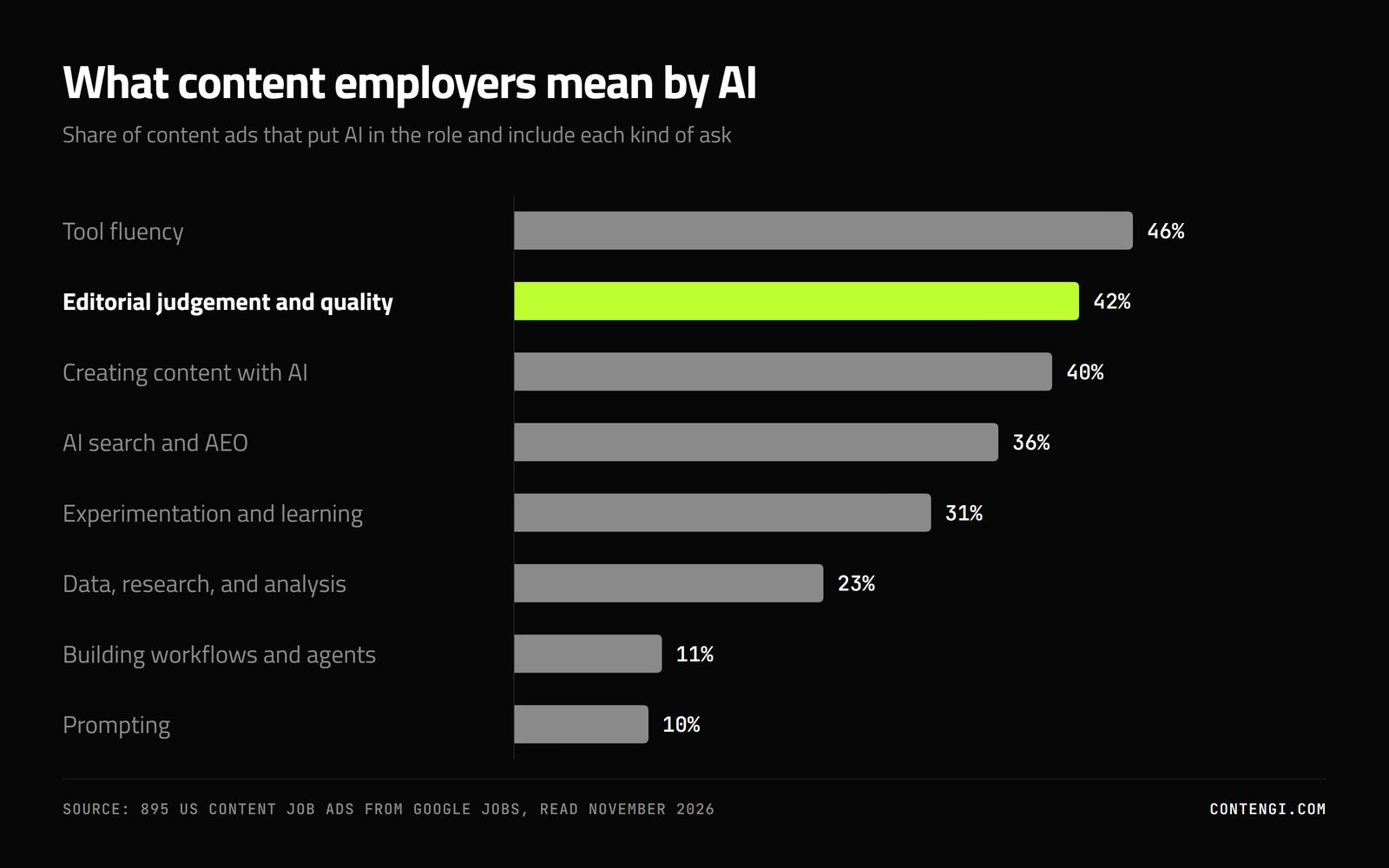
Share of content ads that put AI in the role and include each kind of ask (one ad can include several):
| Kind of AI ask | Content ads | GTM ads, for comparison |
|---|---|---|
| Tool fluency | 46% | 41% |
| Editorial judgement, quality, and responsible use | 42% | 30% |
| Creating content with AI | 40% | 3% |
| AI search and AEO | 36% | 1% |
| Experimentation and learning | 31% | 22% |
| Data, research, and analysis with AI | 23% | 26% |
| Building AI workflows and agents | 11% | 35% |
| Prompting | 10% | 7% |
Tool fluency is the floor
Nearly half of the AI-asking content ads want plain fluency with AI tools, the content equivalent of "proficient in Microsoft Office". Wpromote's content marketing manager ad lists "AI productivity tools such as ChatGPT or Claude" in the same breath as Google Analytics, Google Search Console, SEMrush, Adobe Analytics, and Asana. AI has joined the toolkit line, right next to the tools everyone already expects.
Creation is assumed, and checked
40% of the ads ask for content creation with AI: drafting, AI-assisted writing, AI video, and AI images. The interesting part is how often the creation line comes with a condition attached. Montrose Environmental wants "familiarity with AI tools for research, ideation and productivity while maintaining original thinking, accuracy and authentic storytelling."
Employers want the speed, minus the beige mush that speed without a standard tends to produce.
Prompting faded into the background
Only 10% of the AI-asking content ads mention prompting. Two years ago "prompt engineering" was the AI skill content people put on their CVs. In 2026 it's absorbed into fluency, the same way nobody lists "can write a Google search" as a skill.
The two big content-specific asks
Two categories set content apart from every other function. Editorial judgement (42%) and AI search (36%) barely show up in GTM ads, and they're the reason the next two chapters exist.
The editor's eye

42% of US content ads that put AI in the role also ask for editorial judgement: quality control, accuracy, original thinking, brand voice, or a human who owns the output. That's the highest rate of any group we studied. Across all marketing, content, and GTM ads it's 36%.
The wording is close to identical across companies that have never met:
Fluent with AI tools like Claude, ChatGPT, and Gemini as part of your day-to-day workflow, with the ability to tell good output from output that needs work.
BreachLock
Working fluency with AI-assisted drafting, and the editorial judgment to hold quality across it.
Amwell
A sharp editor's eye for AI-generated copy that sounds right but is not.
Monks
Hands-on fluency with AI tools in content work, and clear views on where people must stay in charge.
Fivetran
Working knowledge of SEO, audience insights, content performance and the responsible use of AI in content workflows.
Stantec
Why employers ask for both
Content teams have used AI long enough to know what it produces when nobody checks: confident, tidy, plausible copy that sounds like every other company's confident, tidy, plausible copy. Volume stopped being the hard part a while ago, so quality is now the job.
Content marketers say the same about themselves. In HubSpot's research, 46% of marketers said they were only somewhat confident they would know if generative AI output were inaccurate, and only 4% use AI to write entire pieces of content. Of the marketers who use generative AI for content, 53% use it for content quality assurance.
The B2B numbers make the point sharper. 88% of B2B marketers say their organisation uses AI-powered content creation tools. Asked what generative AI contributed to their content, they named speed (78%), efficiency (59%), and volume (44%), with performance improvement at 12%. AI made content teams faster, making the content better is still a human job, and that human is who the job ads are hiring.
What the editor's eye covers
The judgement lines in our sample ask for four distinct things:
- Spotting bad output. Telling good from plausible, catching errors, and checking facts.
- Holding a standard. Keeping voice, brand, and accuracy consistent across work AI helped produce.
- Deciding where AI goes. Knowing which tasks to hand over and which to keep, and saying so out loud.
- Owning the result. Taking responsibility for what ships, whoever or whatever drafted it.
Good editors have always done all four. In 2026 the job ad writes them down next to the AI line, as a pair.
AEO joins the content job

Answer engine optimisation is now part of the content job description. 11.1% of US content marketing ads mentioned AEO, GEO, or AI search in our 2026 window, up from 4.7% in 2025 and 0.1% in 2024. Across all marketing ads the figure is 3.2%.
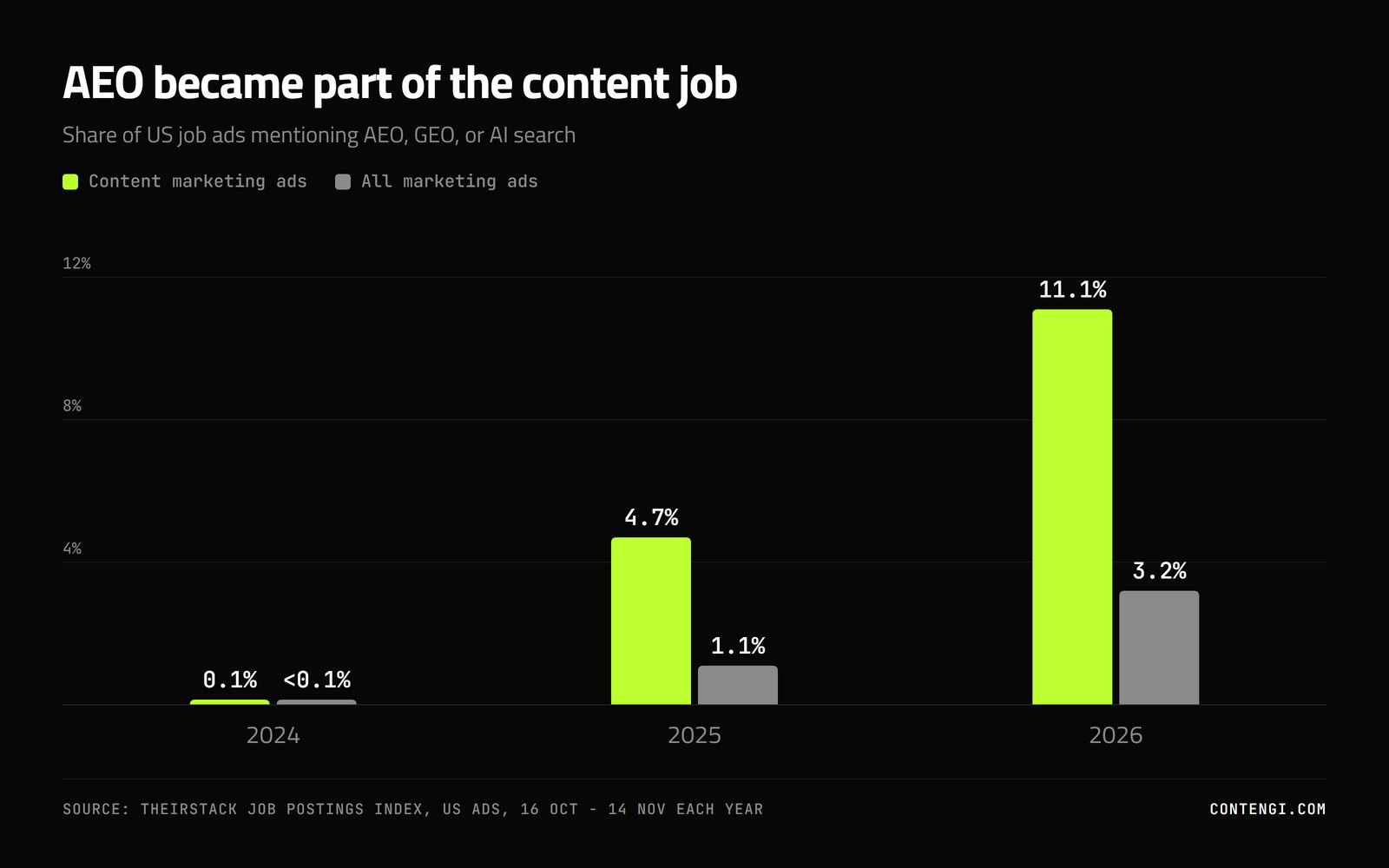
In the reading sample, AI search shows up in 36% of the content ads that put AI in the role. SEO titles carry the highest AI rates in content: 68% of SEO manager ads, 55% of SEO content manager ads, and 51% of SEO specialist ads put AI in the role.
The ads describe AEO as part of normal search work:
Develop our approach to SEO and AEO/GEO across Google, ChatGPT, Claude, Perplexity, Gemini, Reddit, YouTube, and whatever comes next.
Fairmarkit
Run the SEO and AEO program: research what buyers search for and ask ChatGPT, Perplexity, Gemini, and Claude, then structure each piece so it ranks and gets cited.
Cogent Security
Strong understanding of SEO, GEO, AEO and emerging AI-powered search trends and digital content best practices.
Montrose Environmental
Experience with AI search optimization and emerging AI-driven content discovery platforms.
Adrenaline
Why it landed on content
The reason is visible in how people search. In a Pew Research Center study of 68,879 Google searches by US adults, 18% of searches generated an AI summary. When one appeared, people clicked a traditional search result in 8% of visits, against 15% when there was no summary.
When fewer people click, getting cited inside the answer becomes the goal. Answer engines quote pages that answer directly, name things clearly, and cite primary sources, which is a description of good content. So the requirement landed on the people who write it.
What AEO looks like as a skill
Reading the AEO lines, employers want three things from a content marketer:
- Writing for extraction. Answering the question in the first lines under each heading, so an answer engine can lift the passage.
- Researching answers as well as keywords. Asking ChatGPT, Gemini, Perplexity, and Claude what buyers ask, and checking who they cite.
- Tracking visibility. Knowing whether the brand gets cited in AI answers, and refreshing the pages that don't.
Two years ago this was a niche corner of SEO. In 2026 it's in one in nine content ads, and it will be in more.
The tools on the ad

Canva is the most-named tool in US content marketing ads, at 10.5%. Claude, Anthropic's AI model, is the most-named AI tool, at 6.4%, ahead of ChatGPT at 5.1%.
| Tool | Share of US content ads, 2026 |
|---|---|
| Canva | 10.5% |
| Excel | 8.0% |
| Claude | 6.4% |
| Google Analytics | 5.9% |
| ChatGPT | 5.1% |
| Figma | 4.6% |
| HubSpot | 4.6% |
| Salesforce | 3.6% |
| Gemini | 2.0% |
| Perplexity | 1.3% |
| Copilot | 1.1% |
| Notion | 1.1% |
| Jasper | 0.5% |
| Midjourney | 0.3% |
The Claude and ChatGPT flip
In the index, ChatGPT led Claude in content ads by more than five to one in 2025, at 4.98% against 0.91%. In 2026 Claude led, at 6.36% against 5.07%.
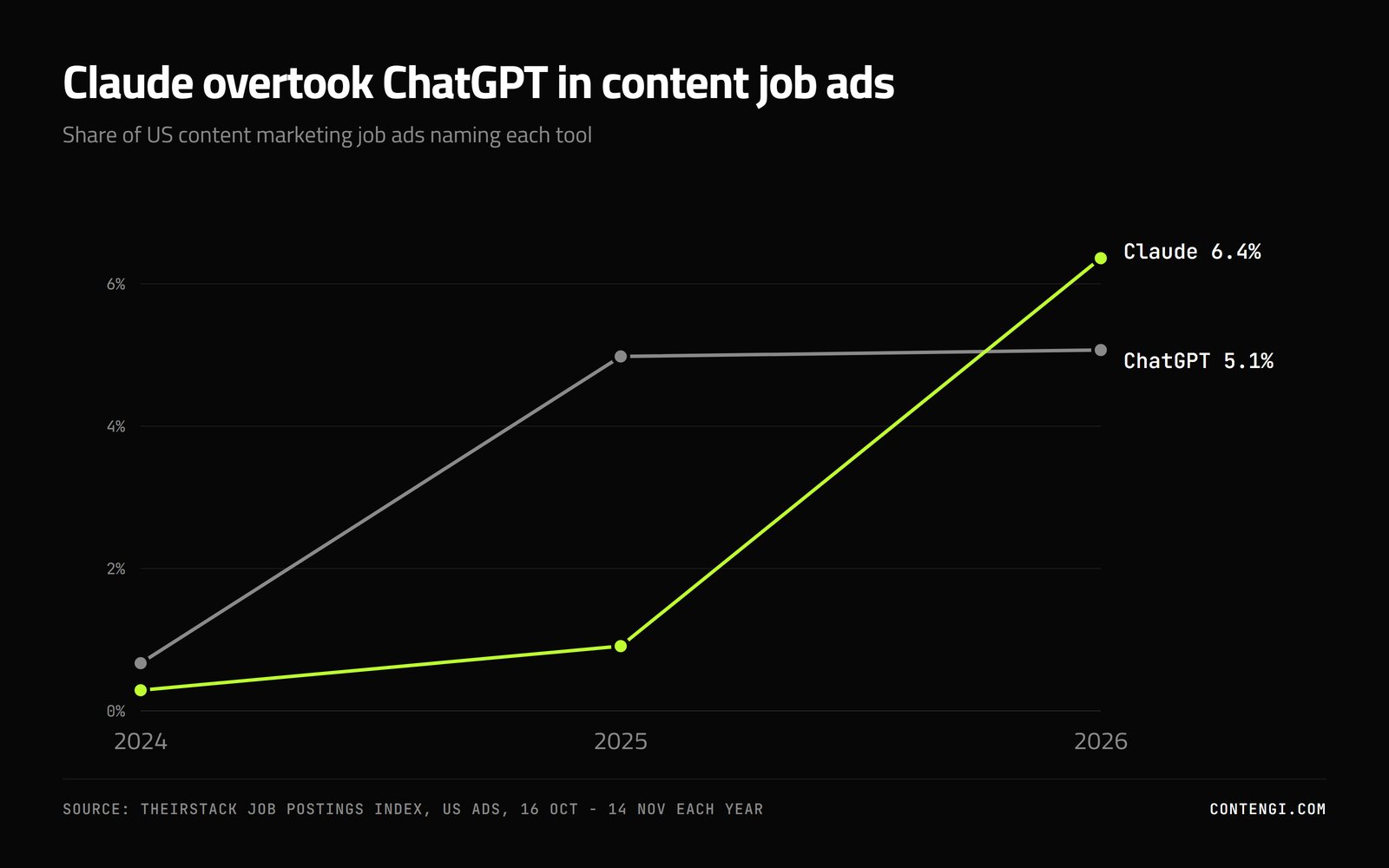
One note for accuracy. In our smaller reading sample of 895 content ads, ChatGPT still appears more often than Claude, at 7.2% against 4.4%. The sample is search-ranked and leans toward media and agency roles, so we give more weight to the index, which covers every content ad in the window. Either way, the two are now close, and both are a long way ahead of every other AI tool.
The point tools faded
Jasper and Midjourney were the faces of AI content in 2023. In 2026 Jasper appears in 0.5% of content ads and Midjourney in 0.3%. Employers name the general-purpose models and expect content people to bend them to the task. The single-purpose AI writing tool has all but disappeared from the job description.
The visual side of the job stayed
Canva (10.5%) and Figma (4.6%) together show that content roles still carry a lot of visual work. That fits the creation asks in chapter 3, where AI video and image tools turn up next to writing. A content marketer in 2026 is expected to ship the post, the graphic, and often the video too.
Which content roles get asked

AI requirements vary a lot by content job title. In our reading sample, the share of ads that put AI in the role runs from two in three for SEO managers to under one in 10 for social media managers.
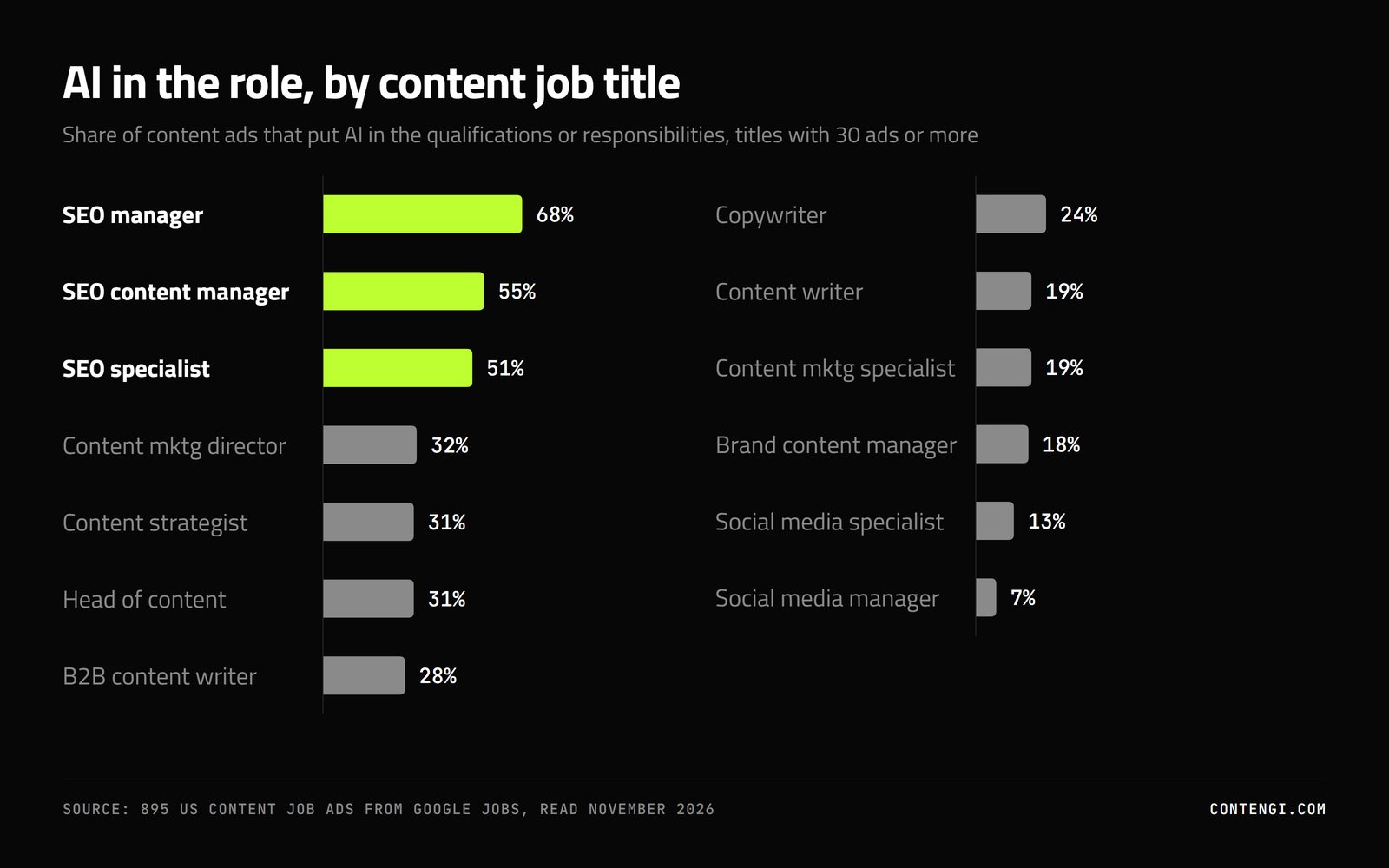
| Content job title (30 ads or more) | Ads read | AI in the role |
|---|---|---|
| SEO manager | 62 | 68% |
| SEO content manager | 76 | 55% |
| SEO specialist | 45 | 51% |
| Content marketing director | 34 | 32% |
| Content strategist | 88 | 31% |
| Head of content | 72 | 31% |
| B2B content writer | 43 | 28% |
| Copywriter | 86 | 24% |
| Content writer | 84 | 19% |
| Content marketing specialist | 64 | 19% |
| Brand content manager | 33 | 18% |
| Social media specialist | 45 | 13% |
| Social media manager | 61 | 7% |
Search roles lead, social trails
The SEO titles lead because AI search changed their job first (chapter 5). Senior content roles come next, with content directors, strategists, and heads of content all around 31%, which matches the wider pattern where senior roles carry the highest AI expectations. Writers and copywriters sit in the middle. Social media roles rarely name AI in writing, which says more about how those ads get written than how the work gets done.
Company size doesn't change much
| Content ads, 2026, by company size | Ads | AI-skills language (broad measure) |
|---|---|---|
| 1 to 50 employees | 489 | 25.8% |
| 51 to 500 employees | 838 | 29.5% |
| 501 to 5,000 employees | 804 | 25.6% |
| More than 5,000 employees | 890 | 28.3% |
Across all marketing, the largest companies ask for AI skills least. In content, the rate is flat across every company size, at 26% to 30%. A content role at a 20-person startup and one at a global enterprise face roughly the same AI expectations. Mid-size companies, with 51 to 500 people, ask most often.
Remote and on-site
In the index, on our broader measure, remote content ads used AI-skills language at 25.0%, level with the 26.6% across all content ads. Our reading sample shows a larger difference, with 42% of remote content ads putting AI in the role against 27% of on-site ones, though the sample's mix of remote roles leans toward agencies and tech. The safe reading: content roles ask for AI wherever the work happens, and remote roles ask at least as often.
Content engineering is the next requirement

The building ask is still rare in content, and it's the one to watch. 11% of AI-asking content ads want someone who builds AI workflows, automations, or agents. In GTM roles it's 35%.
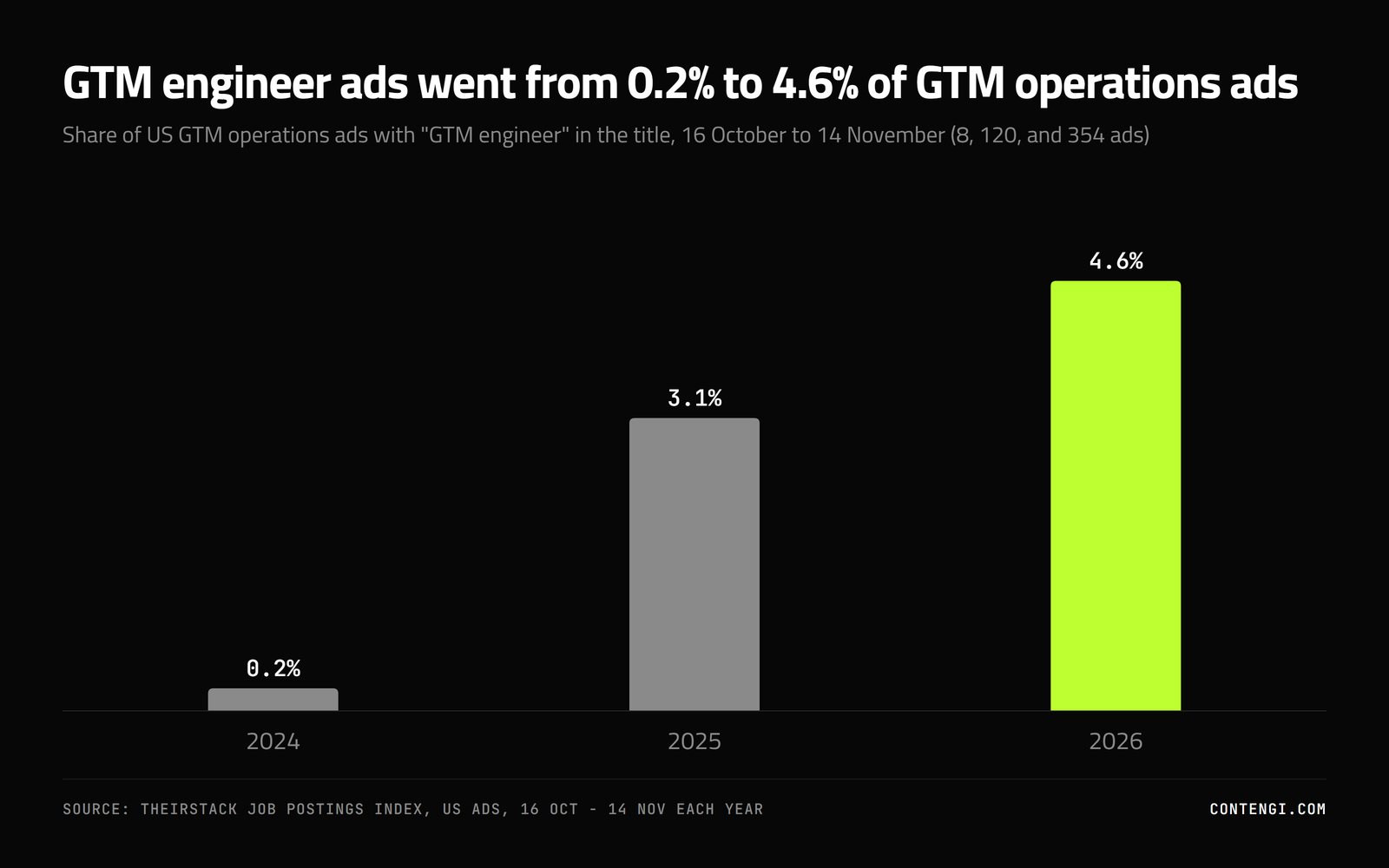
GTM shows where content is heading. Ads with "GTM engineer" in the title went from 0.2% of GTM operations ads in our 2024 window to 4.6% in 2026, or from eight ads to 354, and 74% of the GTM engineer ads we read put AI in the role.
Sales and revenue teams got there first because their work is easy to see as a system: a lead comes in, gets enriched, gets routed, gets a sequence, and books a meeting. Each step has a tool, and each tool has an API. A GTM engineer builds the chain and decides where the AI sits in it.
Content runs on a system too. Research, briefs, drafting, editing, fact-checking, publishing, distribution, and refreshing old posts. Each step can be designed, documented, and partly handed to AI, with a person signing off where it counts. The people who build that chain are what the market has started calling content engineers.
The first content builder ads
A handful of content ads already ask for it, and their wording tells you what the role looks like:
You've built content workflows with AI, with specific examples of what it changed.
Vibe.co
Build workflows that take one brief to hundreds of on-brand variants, using Claude and our creative tools.
Vibe.co
The role also builds and directs AI agents that scale content production, with a human editorial standard on everything that ships.
Personetics
Those three lines contain the whole job: a system, a standard, and a human sign-off.
Agents are coming to content teams
The survey data says content teams are already moving. 59% of B2B marketers use or experiment with AI agents, up from 28% a year earlier, and among those using agents, 69% use them for content management. When most teams run agents, the job ads will ask for people who can build and supervise them. GTM shows that takes about a year to show up in hiring.
What a content engineer needs
From the builder lines in our sample and the GTM ads that went first, the content engineer's toolkit looks like this:
- A written standard. Voice, banned phrases, sourcing rules, and structure, written so an agent can follow it.
- A designed workflow. The steps from idea to published piece, with clear points where AI works and where a person checks.
- Connected tools. The CMS, the analytics, the search data, and the AI models, wired together through automation tools or a platform that does it for you.
- A quality gate. Checks that run before anything publishes, from facts and links to voice and AEO structure.
- A refresh loop. Search and AI visibility data feeding back into which pages to update next.
The person for this job knows what good content looks like and can write it down precisely enough for a machine to follow, and a computer science degree is optional.
What content roles with AI pay

Content ads that put AI in the role advertise higher pay. Across the 289 content ads in our sample with an annual salary, the median was $105,500 where AI was part of the role and $83,500 where it wasn't.
| Median advertised salary | AI in the role | No AI in the role |
|---|---|---|
| Content | $105,500 | $83,500 |
| Marketing | $137,500 | $107,500 |
| GTM | $140,000 | $105,000 |
| All roles | $125,000 | $95,000 |
The difference is $22,000 in content, the smallest of the three groups in absolute terms, and still about a quarter on top of the no-AI median.
Ads that ask for AI lean senior and lean toward technology companies, and both pay more on their own. We didn't adjust for seniority, location, or industry, so the gap mixes the effect of AI with the effect of the roles that tend to ask for it. What the data does show is that we found no group where ads asking for AI paid less.
What this means

The job ads are a brief. Here's how to use it, depending on where you sit.
For marketing leaders
- Hire for the pair. The content people you want work with AI every day and have the judgement to reject most of what it produces. Put both in the job ad and test both in the interview.
- Own the standard. The ads that ask for a high bar on what goes out the door assume someone defined the bar. Voice, sources, structure, and banned phrases belong in writing, signed off at leadership level, before AI scales them.
- Fund AEO as part of content. If buyers ask ChatGPT, Gemini, and Perplexity before they reach your site, AI visibility is a content budget line and a content KPI.
- Budget for systems and the people who build them. GTM teams already fund GTM engineers. Content will need the same role, someone who designs the workflow, wires the tools together, and keeps the quality gates honest.
For content leads
- Say what AI fluency means on your team. "Experience with AI tools" screens for nothing. Name the jobs AI does in the role, from research and first drafts to repurposing and refreshes.
- Ask for evidence. The strongest content ads ask for a workflow the candidate built and what it changed. Ask to see it.
- Test the editor's eye. Hand candidates an AI draft with a few plausible errors and see what they catch. That one exercise covers half of the 2026 job description.
- Plan one builder role. GTM teams have GTM engineers. Content teams will have content engineers. Decide now whether that's a hire or a skill you grow inside the team.
For content marketers
- Name your tools and what you do with them. "Claude for research briefs and first drafts, Perplexity for source checks" beats "AI-savvy" on any CV.
- Show one workflow. What went in, what came out, how much time it saved, and where you stepped in.
- Bring an edit. Show the draft AI produced and the version you shipped, and explain every change. That's the judgement half of the job on one page.
- Learn AEO properly. How answer engines choose sources, how to structure a page so it gets cited, and how to track whether it does.
- Turn your taste into rules. The content people these ads describe can write down what makes their work good, precisely enough for an agent to follow it. That's the skill that turns a writer into a content engineer.
What we expect in 2027

These are our expectations, based on the trends in this report. We'll check them against next year's numbers.
- Two in five content ads ask for AI skills. At the pace of the past two years, the share passes 40% during 2027.
- AEO becomes standard in content and SEO hiring. It moves from one in nine content ads to a default line in every SEO and content strategy ad.
- Content engineer becomes a title. The building ask grows from 11% of AI-asking content ads toward the level GTM reached in 2026, and the title follows.
- Named AI tools plateau. As AI becomes assumed, ads stop naming specific tools, the same way they stopped naming Google Workspace, and the capability language keeps growing.
- The judgement ask gets sharper. Expect more ads that test it directly, with editing exercises and portfolio reviews that ask what you threw away.
Method and limits
Data sources
TheirStack job postings index. We queried TheirStack's index of job postings, which collects ads from company career sites and job boards and removes duplicates, on 15 November 2026. Each count returns the number of US ads that match a set of job title and description keywords in a date window.
Google Jobs reading sample. We pulled US job ads from Google Jobs through SerpApi on 15 November 2026, removed duplicates by title and company, and kept 895 content ads across 19 content and SEO titles. Google Jobs returns each ad's description and, for most ads, a split into qualifications, responsibilities, and benefits. Comparison figures for marketing and GTM roles come from the same pull, which held 1,905 unique ads across 39 titles.
Windows
Year-on-year comparisons use 16 October to 14 November in 2024, 2025, and 2026. The quarterly series uses calendar quarters from January 2025 to September 2026, plus 1 October to 14 November 2026. Company size and remote cuts use the 2026 window.
Matching
We matched job titles and description keywords as described in "About this research". The categories in chapter 3 come from pattern matching on the AI-related lines in each ad's qualifications and responsibilities, and a line can fall into more than one category.
Limits
- Job ads show intent. They tell you what employers ask for, and leave out who they hire and how the work gets done.
- The index grows each year, so we compare shares across years and never raw volumes.
- The reading sample is search-ranked. Google Jobs returns the ads it ranks highest, which leans toward larger job boards and toward Mediabistro, a media and content jobs board that supplied about a fifth of the content ads we read.
- Salaries are medians of advertised annual ranges, with no adjustment for seniority, location, or industry.
- Company size comes from the index's own classification. Content ads without a known company size are left out of that cut.
- Tool names with other meanings. "Jasper" also matches place and person names and "Gemini" matches a crypto exchange. This adds a little noise to the smallest tool counts and doesn't change any finding.
- Descriptions got longer. Job descriptions have grown over the two years, which raises keyword matches slightly on its own. The stricter AI-skills list and the qualifications check limit the effect.
- The provider outage. Our job-index provider stopped answering partway through the re-run on the stricter AI-skills list. The headline figures by year use the stricter list, and the quarterly trend and the size and remote cuts use the broader one.
- US only. We didn't study other countries.
Appendix: data tables
A1. US content marketing ads by year (16 October to 14 November)
| Measure | 2024 | 2025 | 2026 |
|---|---|---|---|
| Content marketing ads in the window | 3,139 | 2,188 | 3,571 |
| Mention AI anywhere | 17.6% | 30.8% | 53.0% |
| Ask for AI skills | 3.4% | 14.5% | 31.2% |
| Name an AI tool | 1.0% | 6.0% | 8.6% |
| Name Google Workspace | 2.7% | 4.2% | 3.7% |
| Mention AEO, GEO, or AI search | 0.1% | 4.7% | 11.1% |
| Name Claude | 0.29% | 0.91% | 6.36% |
| Name ChatGPT | 0.67% | 4.98% | 5.07% |
A2. Content against all marketing, 2026 window
| Measure | Content ads | All marketing ads |
|---|---|---|
| Ads in the window | 3,571 | 41,734 |
| Mention AI anywhere | 53.0% | 32.5% |
| Ask for AI skills | 31.2% | 14.8% |
| AI-skills language, broad measure | 26.6% | 16.4% |
| Name an AI tool | 8.6% | 5.1% |
| Name Google Workspace | 3.7% | 3.0% |
| Name Microsoft Office, Excel, or PowerPoint | 15.1% | 25.9% |
| Name HubSpot or Salesforce | 7.6% | 15.1% |
| Mention AEO, GEO, or AI search | 11.1% | 3.2% |
A3. Quarterly share of content ads with AI-skills language (broad measure)
| Quarter | Content ads | AI-skills language |
|---|---|---|
| Q1 2025 | 9,865 | 5.0% |
| Q2 2025 | 7,780 | 9.0% |
| Q3 2025 | 7,022 | 11.0% |
| Q4 2025 | 6,755 | 14.1% |
| Q1 2026 | 8,937 | 16.4% |
| Q2 2026 | 9,731 | 21.9% |
| Q3 2026 | 10,709 | 20.9% |
| Q4 2026 to 14 Nov | 5,447 | 24.7% |
A4. Reading sample, content ads
| Measure | Content ads |
|---|---|
| Unique ads | 895 |
| AI mentioned anywhere | 37.7% |
| AI in duties or qualifications | 30.5% |
| AI listed as a qualification | 18.8% |
| AI as a hard requirement | 11.8% |
| AI as a bonus | 6.9% |
| AI in the role, remote ads (219) | 42.0% |
| AI in the role, on-site ads (676) | 26.9% |
| Ads with an annual salary | 289 |
Sources
Proprietary data: TheirStack job postings index and Google Jobs (via SerpApi), US job ads, collected 15 November 2026 by Contengi.
Public sources, opened 15 November 2026:
- Content Marketing Institute, B2B content and marketing trends research
- HubSpot, AI trends for marketers report
- Indeed Hiring Lab, January labor market update: jobs mentioning AI are growing amid broader hiring weakness, 22 January 2026
- Lightcast, Four takeaways from the 2026 Stanford AI Index
- LinkedIn, LinkedIn and Adobe launch global AI skills initiative for marketing professionals, 16 June 2026
- Pew Research Center, Google users are less likely to click on links when an AI summary appears in the results, 22 July 2025
About Contengi
Contengi is a content engineering platform for content and marketing teams. It gives a team a brand knowledge base, research, on-brand drafting, quality checks, publishing, and AI visibility tracking in one place. Find out more at contengi.com.